
How to Find Recently Released St. Johns County Inmates
The St. Johns County Sheriff's Office does not publish a standalone daily release log or recent-release list on its public website. Official sources reviewed confirm that the SJSO inmate search is the starting point, and that it may reflect a person's release status within the record after release occurs. The SJSO jail FAQ says the first step after an arrest is to search the inmate search; the same search is the first step when checking whether someone has been released.
If the person does not appear in the SJSO search or their status is unclear, call SJSO booking at (904) 209-3125 or the non-emergency line at (904) 824-8304. Booking staff can confirm whether someone was released, the approximate time, and whether a bond or court order was the basis. For bond releases, the SJSO jail FAQ says the full bond amount can be paid in cash at the jail, or a licensed bondsman can complete the bond. Once bond clears, release processing follows. For inmates held without bond or on pretrial detention, release depends on a court ruling at first appearance or a later hearing.
The Clerk of the Circuit Court's Benchmark case search is a parallel tool. Search the underlying criminal case to look for a bond order, release docket entry, or disposition that might explain the person's status. Felony case questions go to the Clerk criminal division at (904) 819-3618. Misdemeanor questions go to (904) 819-3619. Both lines are open Monday through Friday, 8:00 AM to 5:00 PM.
A step-by-step verification workflow covers the most common paths for confirming a St. Johns County release.
- Search the SJSO inmate search from sjso.org by the person's name.
- If not found or status is unclear, call SJSO booking at (904) 209-3125 or non-emergency at (904) 824-8304.
- Check the Clerk Benchmark case record for bond orders, release entries, or next court date.
- For felony court-date questions, call (904) 819-3618. For misdemeanor, call (904) 819-3619.
- If transferred to state prison, use the Florida Department of Corrections offender search.
- If the person was in federal custody, use the Bureau of Prisons inmate locator.
- Register for custody alerts through VINELink if the facility participates.
Setting Up Release Notifications Through VINELink
VINELink is a national custody status and victim notification service. It lets registered users receive automated phone, text, or email alerts when an inmate's custody status changes at a participating facility. The service covers many Florida county jails and state prisons. If the St. Johns County Detention Center participates, a family member or victim can register for a notification when someone is released, transferred, or escapes.
To set up a notification, go to vinelink.com, select Florida as the state, and search for the offender by name or ID number. The site will show current custody status if the facility is in the network. From the result, you can register to receive alerts by phone or email. Registration is free. VINELink also operates a toll-free number; check the site for current availability. The screenshot below shows the HomeWAV platform, which handles video visitation scheduling for the St. Johns County Detention Center and is separate from VINELink.

HomeWAV at homewav.com handles video visit scheduling for both on-site appointments at the SJSO Video Visitation Center and remote paid visits; while it is a visitation tool rather than a release alert service, families managing an inmate's communication and release process often use both HomeWAV and VINELink together.
VINELink search fields are straightforward. The table below documents the fields available on the platform based on official research.
| Field Label | Type | Required | Notes |
|---|---|---|---|
| State / Location | Dropdown or map | Yes | Select Florida to filter to state and county facilities. |
| Name or Offender ID | Text | Optional | Search by person's name or custody ID number. |
| Notification registration | Registration form | Optional | Register phone or email to receive custody status alerts. |
| Search | Button | n/a | Executes the custody status query. |
Note: VINELink participation varies by facility. Confirm that the St. Johns County Detention Center is listed as a participating agency before registering for alerts. If it is not listed, direct verification by phone remains the most reliable method.
Searching the Florida Department of Corrections
When a person sentenced in St. Johns County receives a sentence of more than a year, they are typically transferred to the Florida Department of Corrections to serve that sentence in state prison. The FDC offender search at dc.state.fl.us covers current inmates, people on community supervision (probation or parole), and people who have been released from FDC custody. It is a free official search tool maintained by the Florida executive branch, separate from the SJSO roster and the Clerk's court system.
The FDC search is useful for several situations: confirming that someone transferred from St. Johns County jail to state prison, checking whether someone on FDC supervision has a new address or officer contact, or verifying a release date from a state sentence. FDC profiles may include release status, supervision end date, and sentence information. Photos may appear in some FDC profile contexts. Verify the live result before relying on it, as FDC records are updated periodically and may not reflect same-day changes.
| Field Label | Type | Required | Notes |
|---|---|---|---|
| DC Number | Text | Optional | Florida DOC identification number; best for exact match when known. |
| Last Name | Text | Optional | Searches by surname; try spelling variations if common name. |
| First Name | Text | Optional | Narrows a name search; not required on its own. |
| Database mode | Search option | Optional | FDC has separate modes for current inmates, supervised releases, and historical records; verify current site navigation. |
| Search / Submit | Button | n/a | Executes the query. |
A typical FDC profile shows the DC number, name, race, sex, date of birth, current facility or supervision status, custody classification, release date or supervision end date if available, sentence and offense information, and admission date. Positive identification cannot be established from an online record alone; contact FDC or use official fingerprint-based identification for formal legal purposes.
Federal Bureau of Prisons Locator
Federal charges in St. Johns County are prosecuted by the U.S. Attorney's Office for the Middle District of Florida and result in federal custody if convicted. St. Johns County is part of the Jacksonville Division of the Middle District. People in federal custody are tracked by the Bureau of Prisons at bop.gov/inmateloc. The BOP locator covers inmates from 1982 to the present and is a free public search tool. If someone is listed as "Released" in the BOP system with no facility shown, they are no longer in BOP custody but may be on supervised release, parole, or in another system.
The BOP warns that release dates shown on its site may not be current because First Step Act sentence reduction credits can change a person's release date without an immediate update to the public-facing record. Always confirm current status directly with the BOP if the release date is time-sensitive.
| Field Label | Type | Required | Notes |
|---|---|---|---|
| Find By Number tab | Search mode | Optional | Search by BOP Register Number, DCDC Number, FBI Number, or INS Number. |
| Type of Number | Dropdown | Yes, if using number search | BOP Register Number; DCDC Number; FBI Number; INS Number. |
| Number | Text | Yes, if using number search | Enter the exact identification number. |
| Find By Name tab | Search mode | Optional | Search by first, middle, and last name plus optional demographics. |
| First Name | Text | Optional | Name search. |
| Middle Name | Text | Optional | Optional, narrows results. |
| Last Name | Text | Required for name search | Surname field for name-based lookups. |
| Race | Dropdown | Optional | BOP race categories; verify current dropdown values on live site. |
| Sex | Dropdown | Optional | Male / Female choices; verify on live site. |
| Age | Number | Optional | Approximate age to narrow results. |
| Search | Button | n/a | Executes the query. |
BOP profiles typically show the register number, name, age, race, sex, current facility or "Released" status, and projected release date where available. For federal cases originating in St. Johns County, filings and dockets are accessible through PACER at pacer.uscourts.gov using the Jacksonville Division of the Middle District of Florida.
Verifying a St. Johns County Release By Phone
Phone verification is the most direct method when online searches are inconclusive. Three phone contacts cover the most common scenarios. For someone who was in the county jail, call SJSO booking at (904) 209-3125. That line handles current custody questions including whether someone has been released and when. For the non-emergency line, use (904) 824-8304. For someone whose underlying criminal case involves felony charges, the Clerk criminal division at (904) 819-3618 can confirm court dispositions and bond orders that may have resulted in release. Misdemeanor case questions go to (904) 819-3619.
All SJSO and Clerk lines are available Monday through Friday, 8:00 AM to 5:00 PM. Weekends and holidays are closed for administrative lines, though the detention center operates continuously. If you are calling about an emergency involving someone in custody, use SJSO non-emergency at (904) 824-8304 and explain the situation.
Florida Sex Offender and Predator Registry
Florida law requires people convicted of certain sex offenses to register with law enforcement upon release. The Florida Department of Law Enforcement maintains the official Sex Offender and Predator registry at offender.fdle.state.fl.us. The SJSO also links to this resource from its sex-offender resource page, which describes the Statewide Predator Offender Technology system and notes that FDLE offers a free public hotline. Registrations include a residential address and employment or school address if applicable.
The SJSO sex-offender page references OffenderWatch and FDLE as the two primary registries for St. Johns County. FDLE's reminder on the registry is important: positive identification cannot be established without fingerprint comparison, so the registry is a reference tool, not a legal determination of identity.
| Field Label | Type | Required | Notes |
|---|---|---|---|
| Global search / Name | Text | Optional | Search by offender or predator name. |
| Area / Address / County / ZIP | Search mode | Optional | FDLE supports area searches; select St. Johns County for local results. |
| Search | Button | n/a | Executes the query against the FDLE registry. |
A typical FDLE sex offender profile shows name and aliases, photograph, designation as sexual offender or sexual predator, physical identifiers, registered residential address, employment and school address if required, offense and conviction information, and registration compliance status. Vehicles and other registration details may appear when they are part of required public disclosure. Use the FDLE registry only for lawful purposes; the data is public to support community safety, not to harass or intimidate registered persons.
The screenshot below shows the Jacksonville Area Legal Aid St. Johns County office page, which provides legal support for people navigating civil matters after release, including housing disputes and benefits issues.
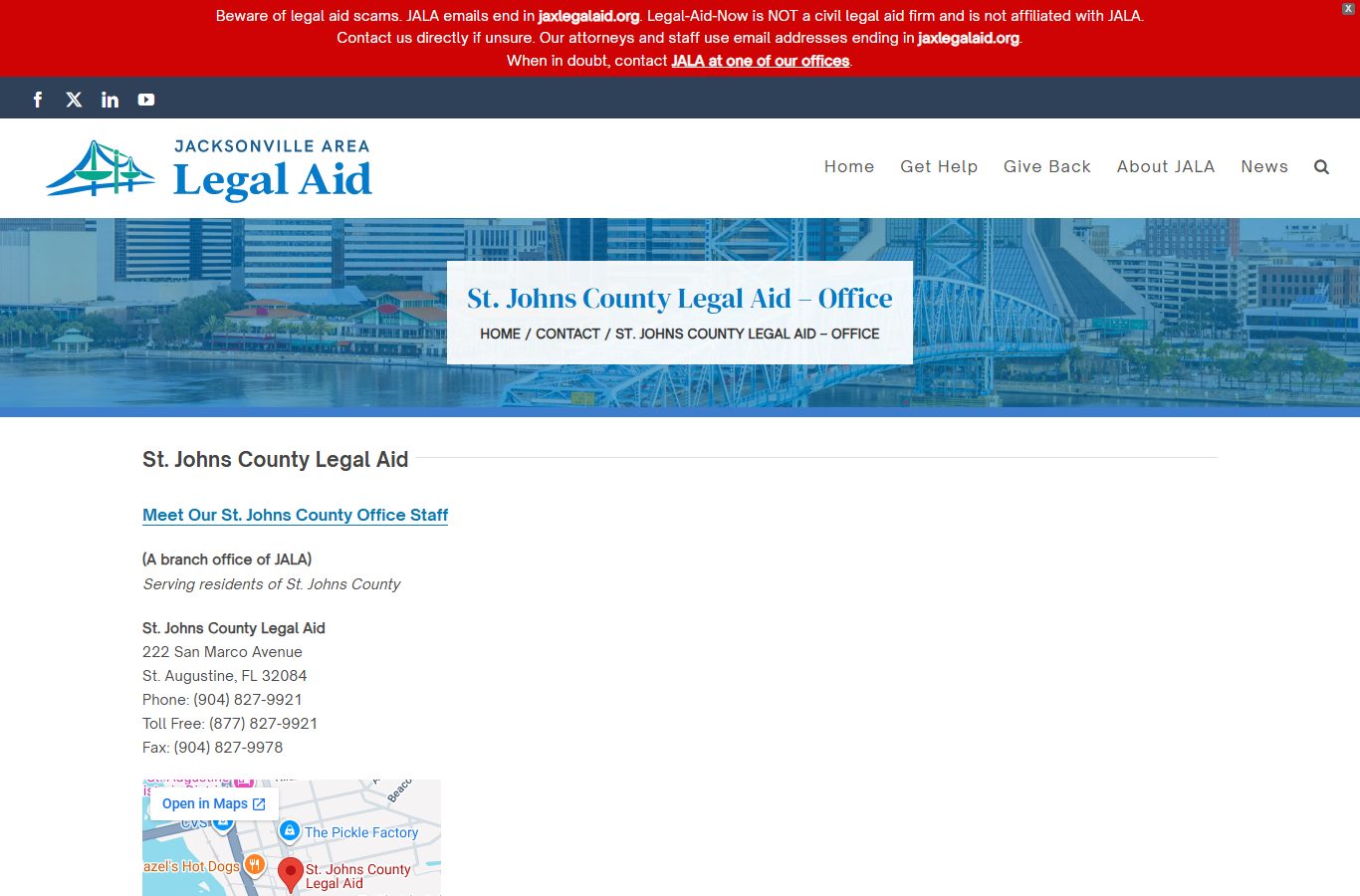
Jacksonville Area Legal Aid's St. Johns County office at jaxlegalaid.org handles civil legal matters for low-income, elderly, and disabled residents, including housing and benefits issues that commonly arise after a person is released from custody.
Parole and Probation in St. Johns County
Florida largely abolished traditional discretionary parole for crimes committed after October 1, 1983. Most people released from Florida prisons after that date are released based on their sentence calculation, not a parole board decision. However, the Florida Commission on Offender Review still supervises some older sentences and handles conditional release, control release, addiction recovery supervision, and some victim cases. People convicted of offenses before 1983 may still be under the Commission's jurisdiction.
For crimes committed after 1983, community supervision after release is typically handled by the Florida Department of Corrections probation and community supervision offices. Probation conditions are set by the sentencing court. A person in St. Johns County on FDC probation reports to their assigned FDC probation officer. If you need to find a person's probation officer or report a violation, contact the FDC regional office that covers St. Johns County. The FDC website at dc.state.fl.us provides regional office contacts and supervision status searches.
For federal sentences, supervised release is managed by U.S. Probation and Pretrial Services. The Middle District of Florida U.S. Probation Office handles supervision for people released from federal custody whose supervision is assigned to the district. Contact information is available through the federal court's website at flmd.uscourts.gov.
Reentry Resources in St. Johns County
People leaving the St. Johns County Detention Center or returning from state or federal custody often need civil legal help, housing assistance, and benefits access. The St. Johns County Legal Aid office is a key starting point. It is operated by Jacksonville Area Legal Aid and handles general civil cases for low-income, elderly, and disabled residents. The Clerk civil page specifically directs low-income users to this office for civil matters. Contact information is below.
St. Johns County Legal Aid (Jacksonville Area Legal Aid)
222 San Marco Avenue
St. Augustine, FL 32084
(904) 827-9921
The Florida Bar Lawyer Referral Service at floridabar.org/lrs can match people who can pay with attorneys and offers a 30-minute consultation for no more than $25. The referral line is 1-800-342-8011, open Monday through Friday, 8:00 AM to 5:30 PM.
For criminal defense and representation, the Seventh Judicial Circuit Public Defender at pd7.org handles appointed representation for eligible defendants in St. Johns County. Applications are at pd7.org/applications. Reentry-specific programs such as housing placement, employment training, and substance use treatment were not listed in detail on official SJSO or court pages reviewed. For current local reentry programs, contact the Florida Department of Corrections at dc.state.fl.us for supervised-release resources, or call SJSO non-emergency at (904) 824-8304 to ask about county-level reentry contacts.
Official sources reviewed did not publish a reentry kit list, transportation program, or halfway-house directory for St. Johns County. Do not rely on unofficial sources for those details; verify with FDC, SJSO, or local nonprofits before making commitments.
Civil Rights Restoration After a Florida Conviction
Florida voters approved Amendment 4 in 2018, which generally restored voting rights to people with felony convictions who complete their sentence, including all terms of probation or parole, with exceptions for murder and sexual offenses. However, the Florida Legislature added a condition that all financial legal obligations such as fines, fees, and restitution must be paid before voting rights are restored. This condition has been contested in court. Before assuming voting rights are restored, check current Florida law and the Florida Division of Elections guidance at dos.fl.gov/elections.
Firearm rights are a separate matter. Under Florida and federal law, a person convicted of a felony loses the right to possess firearms. Restoration of firearm rights in Florida requires a specific legal process. Consult a licensed Florida attorney to understand what steps, if any, are available for the specific offense and sentence.
Employment rights are affected by a conviction record but are not always permanently blocked. Florida does not have blanket statewide ban-the-box legislation for private employers, though some cities and counties have local ordinances. For expunction and sealing of criminal records, which can remove or restrict public access to qualifying arrests, see the criminal records page. The Clerk of the Circuit Court charges $54.00 to file a sealing or expungement petition. FDLE eligibility review is the first step before petitioning the court.