
Florida's County Court Structure
Florida's two-tier trial court system places the circuit court above the county court. County courts are courts of limited jurisdiction, established by Article V of the Florida Constitution to handle matters that do not require the general jurisdiction of the circuit court. Every county in Florida has a county court, and all county court judges are elected constitutional officers. The county court sits one step above where many people first encounter the legal system, whether through a traffic citation, a misdemeanor charge, or a landlord-tenant dispute.
The Florida Supreme Court's court-structure explanation describes county courts as handling the majority of cases filed in Florida each year. In St. Johns County, the same courthouse at 4010 Lewis Speedway houses both circuit and county court proceedings, and the same Clerk's office maintains records for both. A case can start in county court and, if appealed, move to the circuit court, which is why the two courts are closely linked in records and procedure.
The screenshot below is from the Florida Supreme Court's court-structure overview page, which explains how county courts fit into the statewide hierarchy.
The structure chart shows county courts at the base of the state trial court system, with circuit courts above them and the District Courts of Appeal handling first-level appeals from both.
What County Court Handles in St. Johns County
County courts in Florida have four main areas of jurisdiction: misdemeanor criminal cases, traffic matters, small claims, and county civil disputes. Each of these areas generates its own record type in the Clerk's Benchmark system. Understanding the court type helps when filtering a case search.
- Misdemeanor criminal: First and second degree misdemeanors, criminal traffic offenses, county ordinance violations, and municipal ordinance violations. Punishments may include fines, probation, and jail terms up to one year.
- Criminal traffic: Traffic offenses charged as criminal matters, such as driving under the influence, reckless driving, and driving while license suspended in many circumstances. These differ from civil traffic infractions.
- Civil traffic infractions: Non-criminal traffic citations. Speeding, red-light violations, improper lane changes, and most routine citation matters are civil infractions, not criminal charges.
- Small claims: Disputes for $8,000 or less (excluding costs, interest, and attorney fees). Florida calls small claims the people's court because attorneys are not required, forms are available at the courthouse, and procedures are simplified.
- County civil: Civil disputes from $8,000.01 to $50,000, including evictions, unlawful detainer, replevin, and general civil claims within the jurisdictional limit.
- Code enforcement and ordinance: County and municipal code violations appear in Benchmark as code enforcement, county ordinance, or municipal ordinance case types.
The Florida Governor's judicial branch overview explains that county courts are essential to the access-to-justice mission of the state court system. The screenshot below is from that overview page.
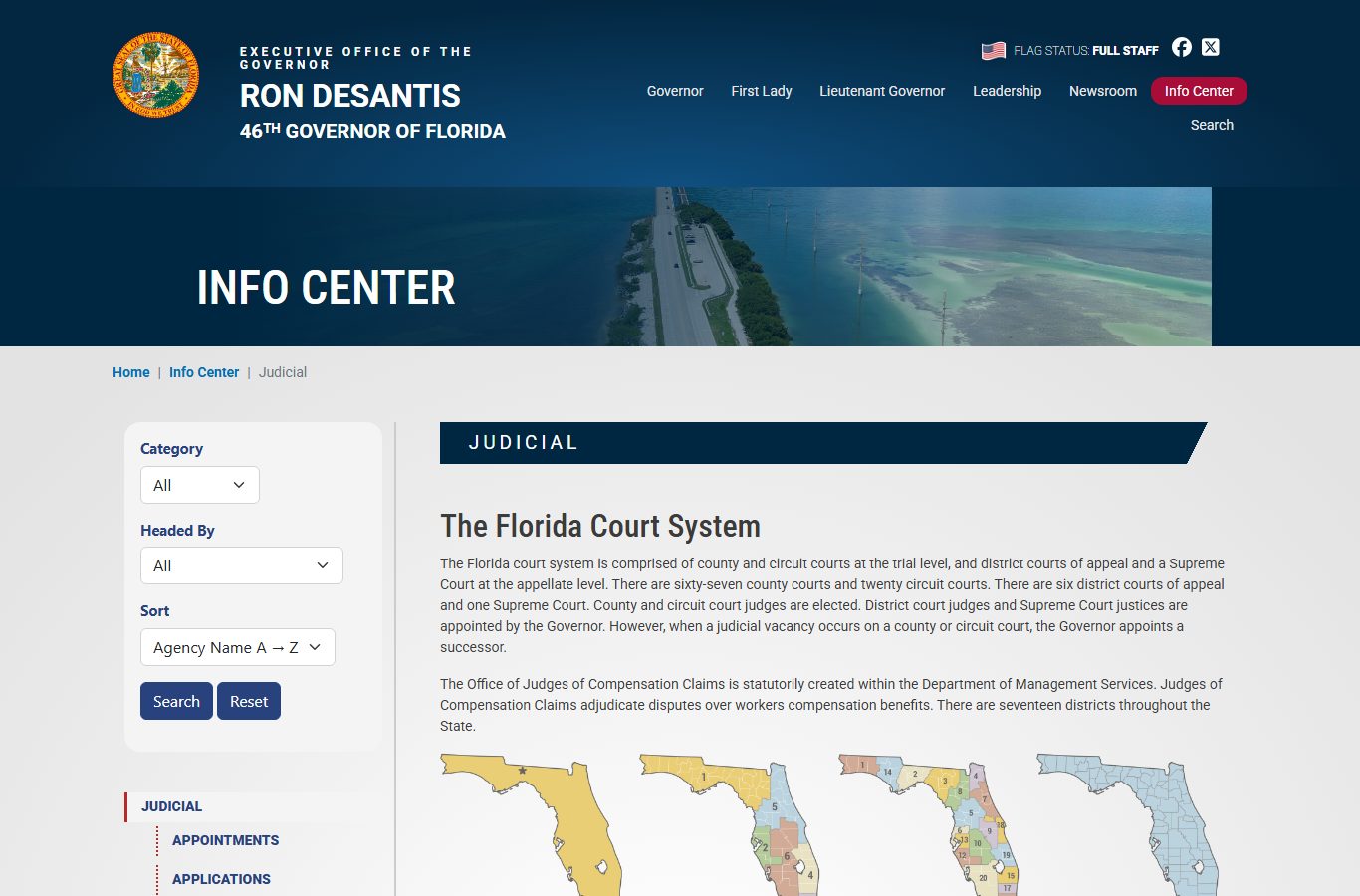
The page describes how both circuit and county courts serve Florida residents at the trial level, with each handling a distinct slice of the court's overall caseload.
County Court Judges in St. Johns County
The Seventh Judicial Circuit assigns three county court judges to St. Johns County. These judges hear misdemeanor criminal cases, traffic matters, small claims, and county civil disputes. They operate from the Richard O. Watson Judicial Center at 4010 Lewis Speedway, St. Augustine, FL 32084. County judges are elected in countywide elections to six-year terms.
Judge Benjamin J. Rich joined the county bench in September 2025 after his appointment by the Governor. He had previously served as the Managing Assistant State Attorney for the Seventh Circuit's St. Augustine office. The other two county judges assigned to St. Johns County are also listed on the Seventh Circuit's St. Johns County judge roster at circuit7.org/st-johns-county. For scheduling questions or matters in a pending county court case, contact the judicial assistant for the assigned judge using the phone numbers listed on that page.
Small Claims Cases in St. Johns County
Small claims is the most accessible division of the county court. Florida Statutes provide for simplified small claims procedures specifically designed so that individuals can represent themselves without an attorney. Attorneys are not prohibited, but they are not required. The Clerk's civil division page refers to small claims as the "people's court" and notes that forms are available online and at the County Civil Division counter.
A small claims case starts with a Statement of Claim that sets out the facts, the parties, and the amount sought. The dollar limit is $8,000, not counting court costs, interest accrued, and attorney fees if any. The filing fee depends on the amount claimed. After filing, the Clerk issues a Notice to Appear, and a hearing is scheduled. Common small claims disputes include unpaid loans, security deposit disagreements, property damage claims, and contract disputes for services or goods.
The small claims fee table from the Clerk's civil division shows the following filing fees:
| Claim Amount | Filing Fee |
|---|---|
| Under $99.99 | $55.00 |
| $100.00 to $500.00 | $80.00 |
| $500.01 to $2,500.00 | $175.00 |
| $2,500.01 to $8,000.00 | $300.00 |
Small claims records appear in Benchmark under the Small Claims court type and under small claims cause-of-action codes. Searching by party name or case number returns the docket with hearing dates, filings, and disposition.
Evictions and Unlawful Detainer
Eviction cases are among the most common county court filings in St. Johns County. Florida law sets out the required notice periods before an eviction suit may be filed. For nonpayment of rent, a three-day written notice is required, not counting the day of delivery, weekends, or holidays. Notices for other lease violations or terminations of tenancy may require seven or thirty days depending on the type of tenancy.
An eviction case record in Benchmark typically contains the statutory notice, the complaint, summons and service return, any tenant answer, motion for default, default, judgment for possession, writ of possession, and sheriff-execution entries. If the landlord also seeks back rent and damages, those proceedings generate additional filings in the same or a related case. The SJSO Court Services division at 3955 Lewis Speedway handles writ-of-possession executions in St. Johns County; the civil process phone is (904) 209-1435.
Unlawful detainer is separate from eviction. It applies when there is no landlord-tenant rent agreement, such as when a person stays on property after a license to remain has been revoked. The Clerk's civil page distinguishes unlawful detainer from eviction because different rules and notice periods apply. Both types appear in Benchmark under the county civil and eviction cause codes. The court records page explains how to search by cause of action in Benchmark.
County Court vs. Circuit Court
Researchers often need to know whether a case they are looking for is a county court matter or a circuit court matter. The comparison below covers the key differences. For a full look at the circuit court, see the circuit court page.
| County Court | Circuit Court | |
|---|---|---|
| Criminal scope | Misdemeanors, criminal traffic, ordinances | Felonies (all degrees) |
| Civil limit | Up to $50,000 (county civil); up to $8,000 (small claims) | Above $50,000 and general jurisdiction matters |
| Family cases | Limited county domestic matters | All dissolution, custody, paternity, injunctions |
| Probate and guardianship | No | Yes |
| Appeals go to | Circuit Court | District Court of Appeal |
| Benchmark court types | Misdemeanor, Civil Traffic, County Civil, Small Claims, County Ordinance, Municipal Ordinance, Parking, Code Enforcement | Criminal Felony, Criminal Traffic, Circuit Civil, Domestic Relations/Family, Probate, Guardianship, Mental Health, and more |
Searching County Court Records in Benchmark
County court records are in the same Benchmark portal as circuit court records. The Clerk's civil division page, shown below, covers county civil, small claims, evictions, replevins, and unlawful detainer and points users to Benchmark for case lookups.
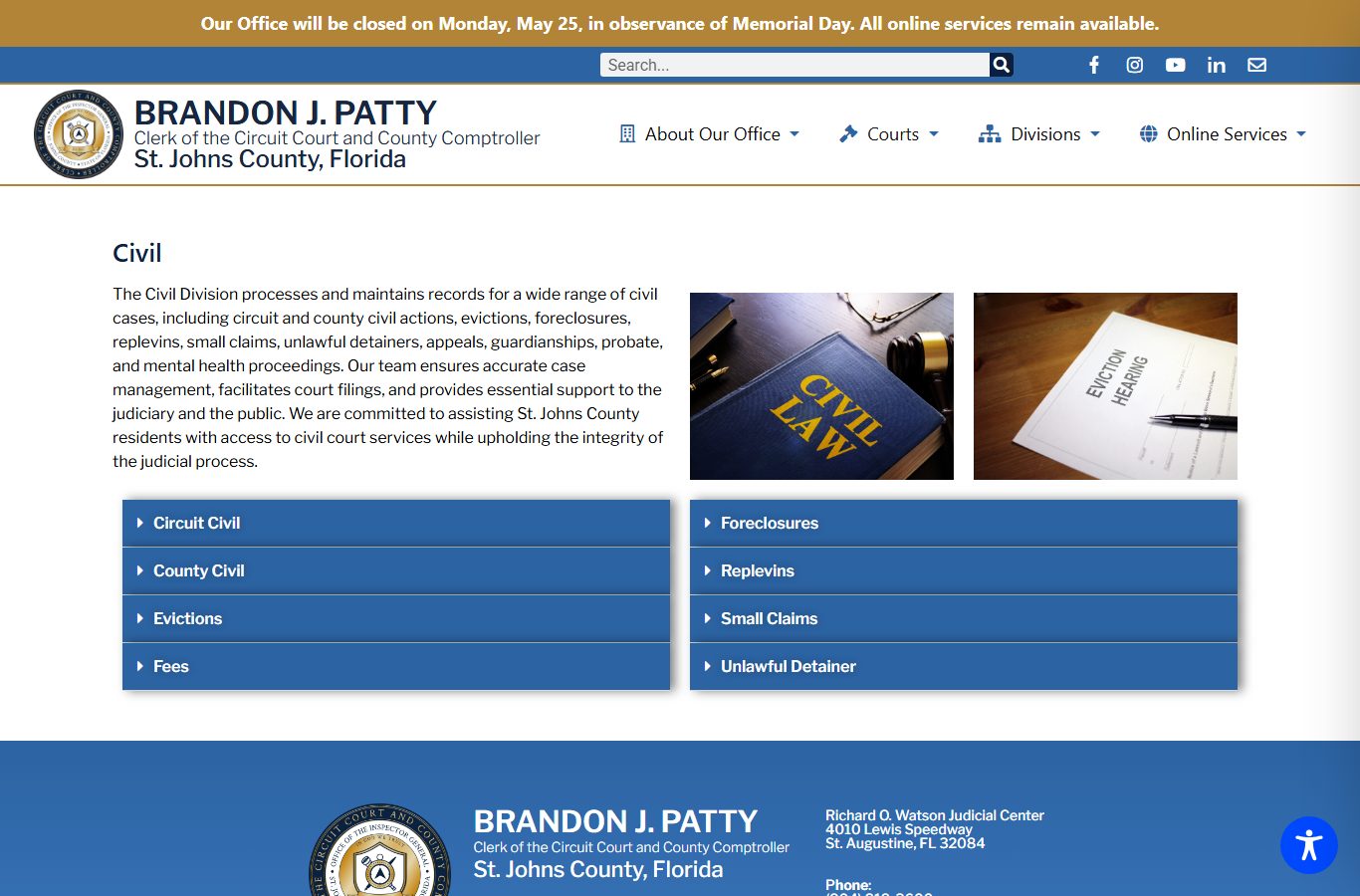
To narrow results to county court matters, use the Court Types filter in Benchmark. Select Misdemeanor for criminal matters, Civil Traffic for traffic infractions, Small Claims or County Civil for money disputes, or Code Enforcement and Parking for ordinance matters. You can also narrow by cause of action, which gives a finer category like a specific eviction type or small claims amount band.
County court records show case number, parties, filing date, court type, cause of action, judge, docket entries, and disposition. Criminal traffic and misdemeanor cases also show charges and statute references. Traffic citations may show a citation number as well as a case number once the matter becomes a court case. If a citation has not yet become a court case, search by citation number in the Citation Number field rather than by case number.
Note: Selecting the correct Benchmark court type before searching cuts down long name-search result lists. For common names, always add a date-opened range or a court type to reduce the number of results returned.
Traffic Cases in County Court
Most routine traffic violations in St. Johns County are civil traffic infractions, not criminal cases. Civil traffic cases appear in Benchmark under the Civil Traffic court type. They do not result in a criminal record, but they can trigger points on a driver's license and, if unpaid, can lead to license suspension and collection referral. The Clerk's traffic division at stjohnsclerk.com/courts/traffic-dept explains payment, proof of compliance, traffic school, and court-appearance options.
Criminal traffic cases are different. Driving under the influence, reckless driving, and certain driving-while-suspended charges are criminal offenses handled by the county court criminal division. They appear in Benchmark under the Criminal Traffic court type and generate a criminal case record with charges, pleas, and sentencing information. DUI cases in particular can escalate to felony level if prior convictions or serious bodily injury are involved, in which case the case moves to the circuit court.
For more detail on traffic record searches, fees, and the distinction between the court traffic record and the state driver record maintained by FLHSMV, see the traffic court records page.