
What Probate Covers in St. Johns County
Probate is the court process for administering a deceased person's estate. The Clerk's probate page defines it as the legal means for validating a will if one exists, identifying and collecting the decedent's assets, paying outstanding debts and taxes, and distributing what remains to beneficiaries or heirs under court supervision. Whether probate is required depends entirely on what the person owned at the time of death. If the decedent solely owned real property, probate is almost always required to transfer title. If all assets pass by beneficiary designation, joint ownership, or trust, the estate may avoid the court process entirely.
The Clerk warns directly on its website that if a decedent solely owned real property, the parties may need an attorney because the Clerk cannot provide legal or procedural advice. Complex estates with real property, creditor claims, or disputes among heirs are not well suited to self-represented administration. Simpler estates with only personal property and modest assets may qualify for a shorter process.
Probate is handled through the Circuit Court's probate division and the Clerk of the Circuit Court at the Richard O. Watson Judicial Center, 4010 Lewis Speedway, St. Augustine, FL 32084. You can learn more about the Clerk's probate services at stjohnsclerk.com/courts/probate.
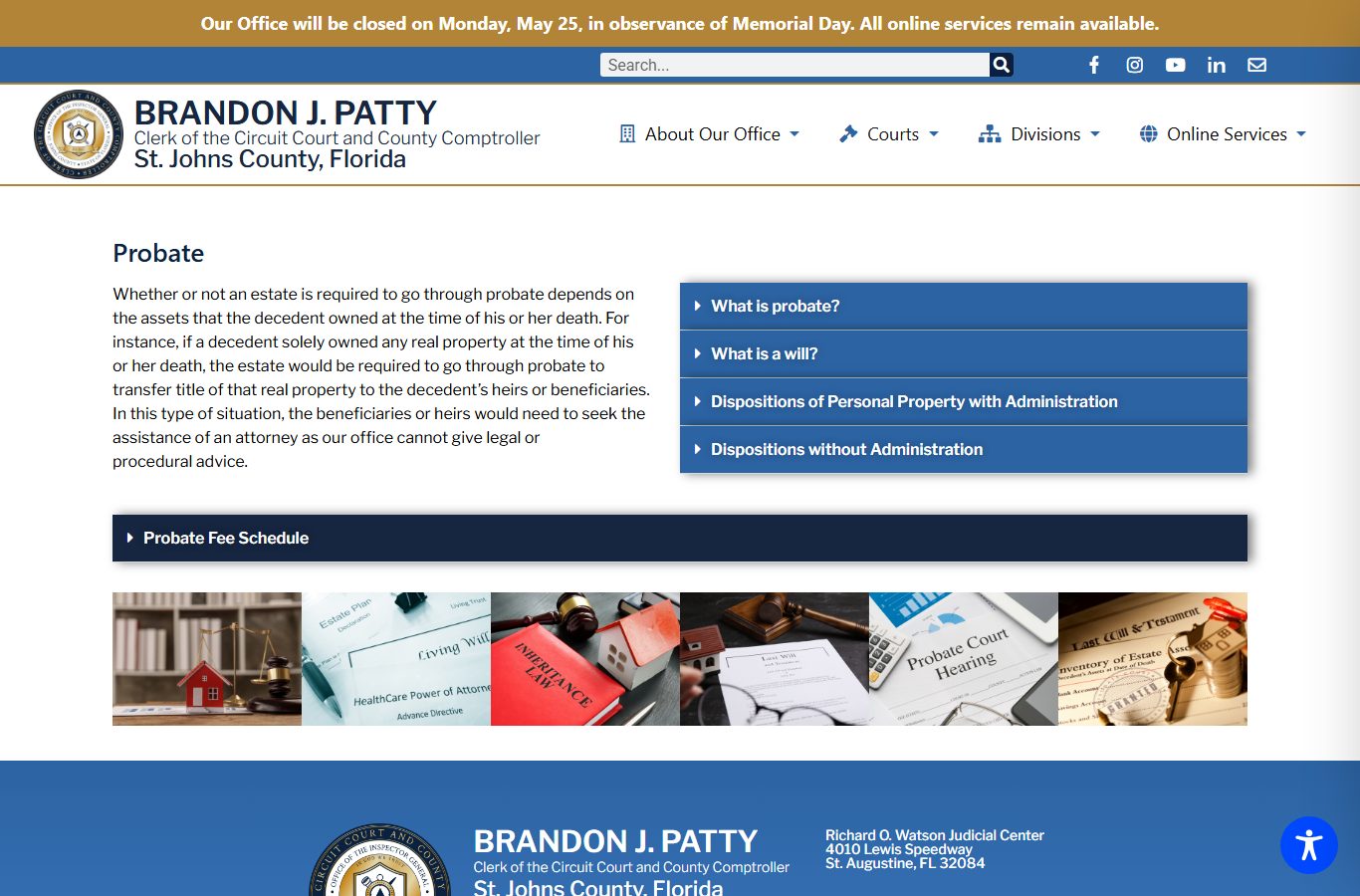
The Clerk's probate page describes the types of probate proceedings, what documents are required, and the filing fee schedule for each proceeding type.
Probate Terms Defined
Probate uses legal vocabulary that can slow down a first-time user. The definitions below cover the most common terms you will encounter in St. Johns County probate records and filings. Understanding these terms makes it easier to read a case record or decide what type of petition to file.
- Testator
- The person who wrote and signed the will. When a testator dies, the will is submitted to the court to be admitted to probate. If the will is valid, the court uses it to guide the estate administration.
- Executor / Personal Representative
- Florida uses the term "personal representative" rather than executor. This is the person or institution named in the will, or appointed by the court if there is no will, to manage and close the estate. The personal representative collects assets, pays debts, and distributes what remains.
- Intestate
- Dying without a valid will. When a person dies intestate, Florida's intestacy laws determine who inherits the estate. The court still supervises the administration, but the distribution follows a statutory order of priority rather than the decedent's written wishes.
- Beneficiary
- A person or entity named in a will or a beneficiary designation to receive property from the estate. Beneficiaries named in a will receive their share after debts, taxes, and costs are paid.
- Guardianship
- Court-supervised authority over a minor's or incapacitated adult's person, property, or both. When a parent dies without naming a guardian, or when an adult can no longer manage their own affairs, the circuit court may appoint a guardian through a guardianship proceeding.
- Conservatorship
- In Florida, the concept of managing someone else's property under court authority is largely handled through guardianship of the property rather than a separate conservatorship proceeding. Some case types in Benchmark relate to property management orders within a guardianship or incapacity case.
How to Search St. Johns County Probate Records
Probate records are searched through the same Benchmark court case portal used for criminal and civil cases. Start at the Clerk's online research hub and choose Court Records to open Benchmark. The portal lets you filter by court type, which is how you narrow to probate. Most modern probate records from roughly the 1990s forward are available online. Older archival records from 1821 through the early 1990s can be accessed on-site at the Clerk's public terminals or by a public records request.
- Open the Clerk's online research hub at stjohnsclerk.com/online-research and choose Court Records.
- In Benchmark, use the Court Types filter and select one or more of: Probate, Deceased Without Administration, Trust (Notice Of Trust), Trust Administration, Wills On Deposit, Caveat, Guardianship, Incapacity, Declaration Pre-Need Guardian, or Mental Health.
- Search by the decedent's or petitioner's name if you do not have a case number. Try spelling variations. Include Alias is an option if the name may appear differently.
- Use the Causes of Action filter to narrow further: options include Formal Administration, Summary Administration, Disposition without Administration, Petition to Admit Foreign Will, Notice of Trust, Petition to Determine Incapacity, and others.
- If you have the case number, search by Case Number for the fastest result.
- For certified copies of probate orders or letters, use E-Certify from Benchmark or contact the Clerk's probate division directly at (904) 819-3600.
Note: Live Benchmark results require JavaScript. The portal works best at 1366x768 resolution or higher. Anonymous public access is available, but registered access may allow more document viewing.
Probate Court and Clerk Office in St. Johns County
St. Johns County does not have a separate standalone probate court with its own elected judge. Probate matters are heard by circuit court judges assigned to St. Johns County through the Seventh Judicial Circuit. The Clerk of the Circuit Court handles all filing, record-keeping, and copy services for probate, guardianship, incapacity, trust, and related proceedings. The Clerk's main office at the Richard O. Watson Judicial Center handles walk-in and phone inquiries for probate matters. There are no probate-only annex offices; the main courthouse is the central location for all probate filings and inquiries.
St. Johns County Clerk of the Circuit Court, Probate Division
Richard O. Watson Judicial Center
4010 Lewis Speedway
St. Augustine, FL 32084
(904) 819-3600
Mon–Fri 8:00 AM–5:00 PM
Probate Filing Fees in St. Johns County
The Clerk's probate page publishes the filing fee schedule for each type of probate proceeding. Fees vary based on the type and size of the estate. Formal and trust administrations carry the highest fees. Smaller proceedings and notices carry lower flat fees. The fee is due at the time of filing and is separate from any attorney fees, appraisal costs, or other professional services involved in settling an estate.
| Proceeding Type | Filing Fee |
|---|---|
| Formal Administration | $400.00 |
| Trust Administration | $400.00 |
| Summary Administration (estate $1,000 or more) | $345.00 |
| Summary Administration (estate less than $1,000) | $235.00 |
| Petition and One Order | $231.00 |
| Petition and Order to admit foreign will | $231.00 |
| Disposition of Personal Property without Administration | $231.00 |
| Petition to Determine Incapacity and Restoration | $231.00 |
| Caveat | $41.00 |
| Notice of Trust | $41.00 |
Copies of probate records cost $1.00 per page. Certification of a document adds $2.00. If you need a certified copy of letters of administration or a final order of discharge, request them from the Clerk at the main office or through E-Certify online.
Disposition without Administration (Small Estate Affidavit)
Florida provides a simplified proceeding called Disposition of Personal Property without Administration, sometimes referred to as a small estate affidavit. The Clerk explains that this process is available when the estate consists only of personal property and the total assets do not exceed the amount of paid funeral expenses and final medical bills. If the estate has any real property at all, this option is not available. If assets exceed the funeral and medical costs, this option is also not available.
To use this process, the petitioner must file the following documents with the Clerk:
- Original Last Will and Testament, if the decedent left one.
- Certificate of Death (an official copy from the issuing authority).
- Funeral bill showing that it has been paid in full and identifying who paid it.
- Copy of the bank statement, stock certificate, or other asset document for the asset being transferred.
The filing fee for this proceeding is $231.00. Because it does not involve real property and does not require full court supervision of an estate, it tends to resolve faster than formal or summary administration. However, the Clerk still cannot provide advice on whether the facts of a specific estate qualify; that determination belongs to an attorney or the court itself.
Guardianship and Incapacity Proceedings
Guardianship in St. Johns County is handled by the same circuit court and Clerk that manage probate. A guardianship petition may be filed when a minor's parents are both deceased or unable to care for the child, or when an adult is alleged to lack the capacity to manage their own person or property. The Benchmark court type for guardianship and incapacity proceedings is separate from the Probate court type, though both are administered through the same Clerk office and judicial division. Use "Guardianship," "Incapacity," and "Declaration Pre-Need Guardian" as Court Types in Benchmark when searching for these cases.
The petition to determine incapacity has a $231.00 filing fee. Once a guardian is appointed, the court supervises the guardianship through annual reports, accountings, and periodic reviews. Guardianship records may be partially restricted to protect the ward's personal and financial information, but the existence of a guardianship case and its status is generally public. If the case involves a minor, certain identifying information may be protected from public view under Florida court rules.
Restricted Records in St. Johns County Probate
Some probate and guardianship records are confidential or have restricted access. Adoption records are confidential under Florida Statutes § 63.162, which means any probate matter connected to an adoption file may have portions that cannot be publicly disclosed. The full adoption court file is not available for anonymous public viewing.
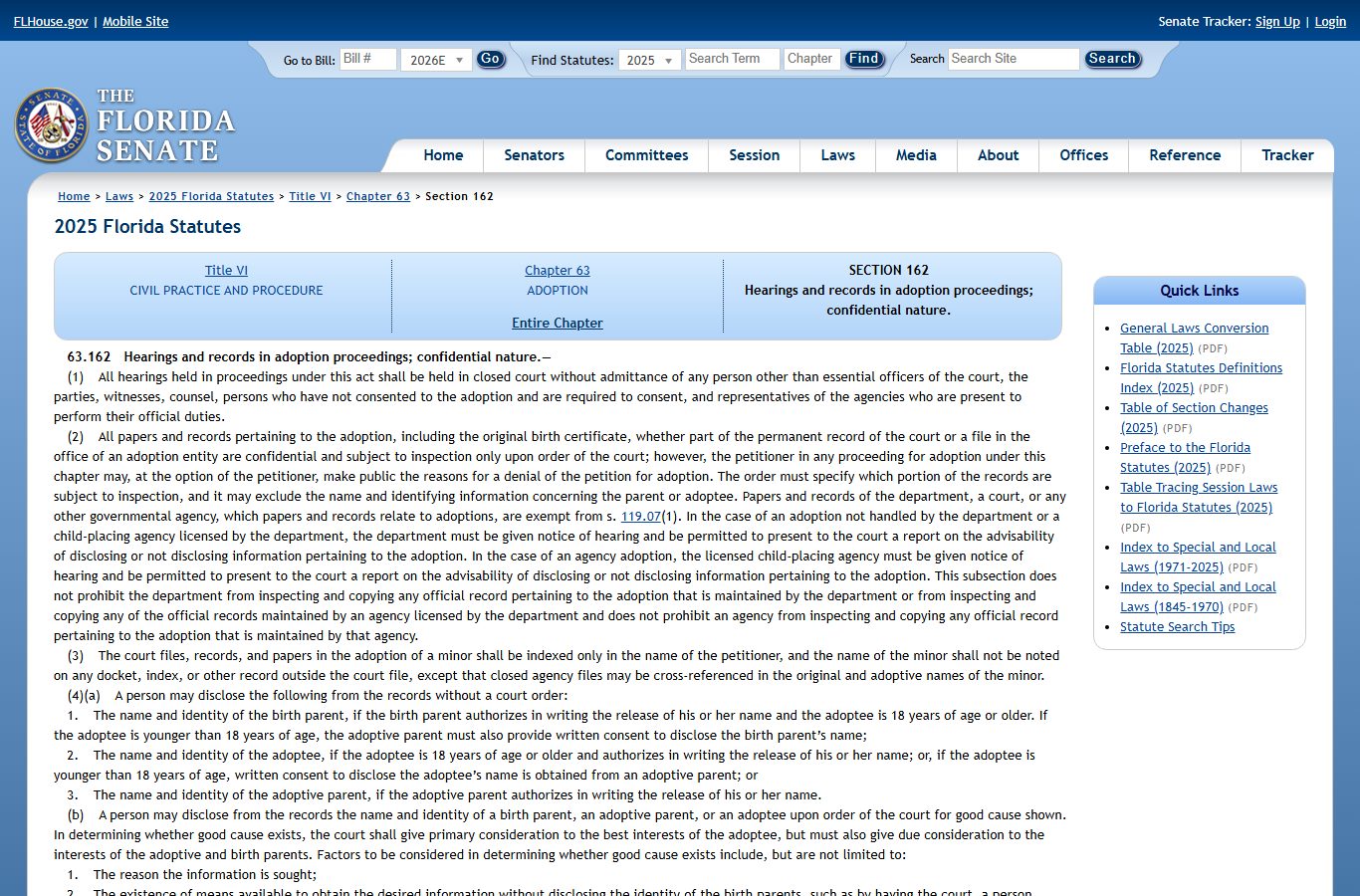
Section 63.162 of the Florida Statutes sets the confidentiality rule for adoption records, which applies when a probate or guardianship case involves an adoptee or an adoption file.
Mental health clinical records are also protected. When a Baker Act or related mental health proceeding intersects with a guardianship or incapacity case, the clinical and treatment records are confidential under Florida Statutes § 394.4615. The existence of the court case may be visible, but treatment records and clinical details will not appear in the public record.
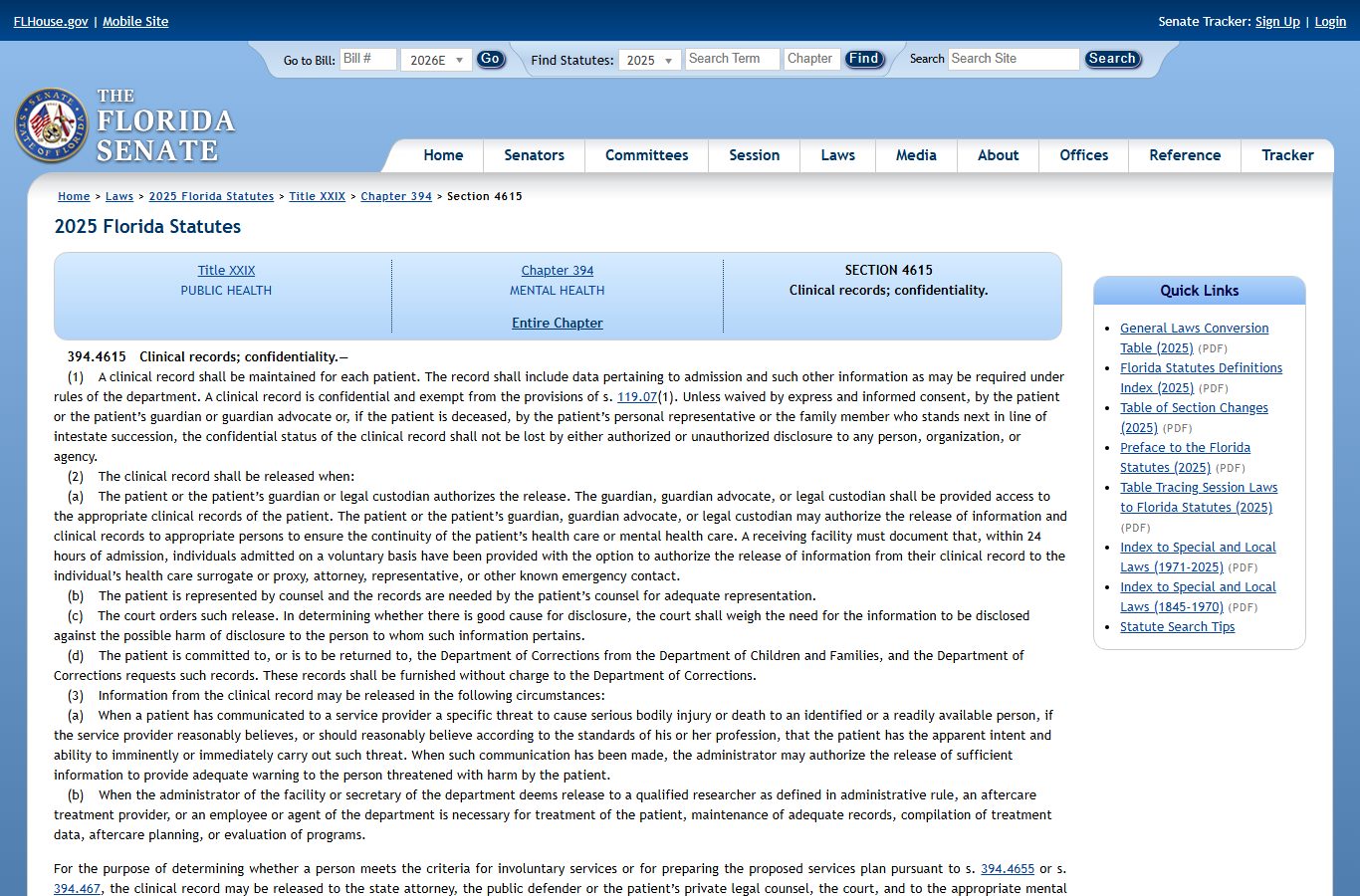
Section 394.4615 protects mental health clinical records from ordinary public disclosure, a rule that limits what is visible when a mental health proceeding appears alongside a probate or guardianship case in Benchmark.
Financial inventories and accountings in guardianship cases may also be restricted if the court finds a reason to limit access. Users who cannot find an expected record online should contact the Clerk at (904) 819-3600 or submit a public records request to determine whether the record exists and under what access rules it is held.
When to Get a Probate Attorney
The Clerk says directly on the probate page that parties may need an attorney if the estate includes real property, because the Clerk cannot give legal or procedural advice. Beyond real property, other situations that typically call for legal help include disputes among heirs, complex asset portfolios, out-of-state property, creditor claims that are contested, trust litigation, and incapacity proceedings where the proposed ward has objections. Formal administration, which applies to most estates not qualifying for the simpler processes, involves court-supervised steps that most self-represented parties find difficult to complete correctly.
For those who cannot afford a private attorney, the Jacksonville Area Legal Aid St. Johns County office at 222 San Marco Avenue, St. Augustine, FL 32084, phone (904) 827-9921, handles civil matters for low-income, elderly, and disabled residents. The Florida Bar Lawyer Referral Service at 1-800-342-8011 can match you with a probate attorney and offers a 30-minute initial consultation for no more than $25.