
How to Search St. Johns County Court Records
Court records for the county are searched through the St. Johns County Clerk's online research hub. Choose Court Records to open the Benchmark portal, the free public case search. Benchmark lets you search by name, case number, citation number, date opened or closed, court type, cause of action, party type, and statute. Recorded papers like deeds and marriage licenses live in a separate system called Landmark. For most people, a case number gives the quickest result.
Before you start, gather what you know about the case. A name search works best with a date range and a court type to trim the list. The Clerk advises trying all spellings of a name. The court search runs in real time, so it shows cases as the Clerk's system has them.
- Open the Clerk's online research page and pick Court Records to enter Benchmark.
- Enter a case number for the narrowest result, or a party name if you do not have one.
- Narrow the list with a Court Type and a Date Opened or Date Closed range.
- Open the case to read the docket entries, parties, and disposition.
- Use Get Certified Documents and E-Certify if you need a certified copy.
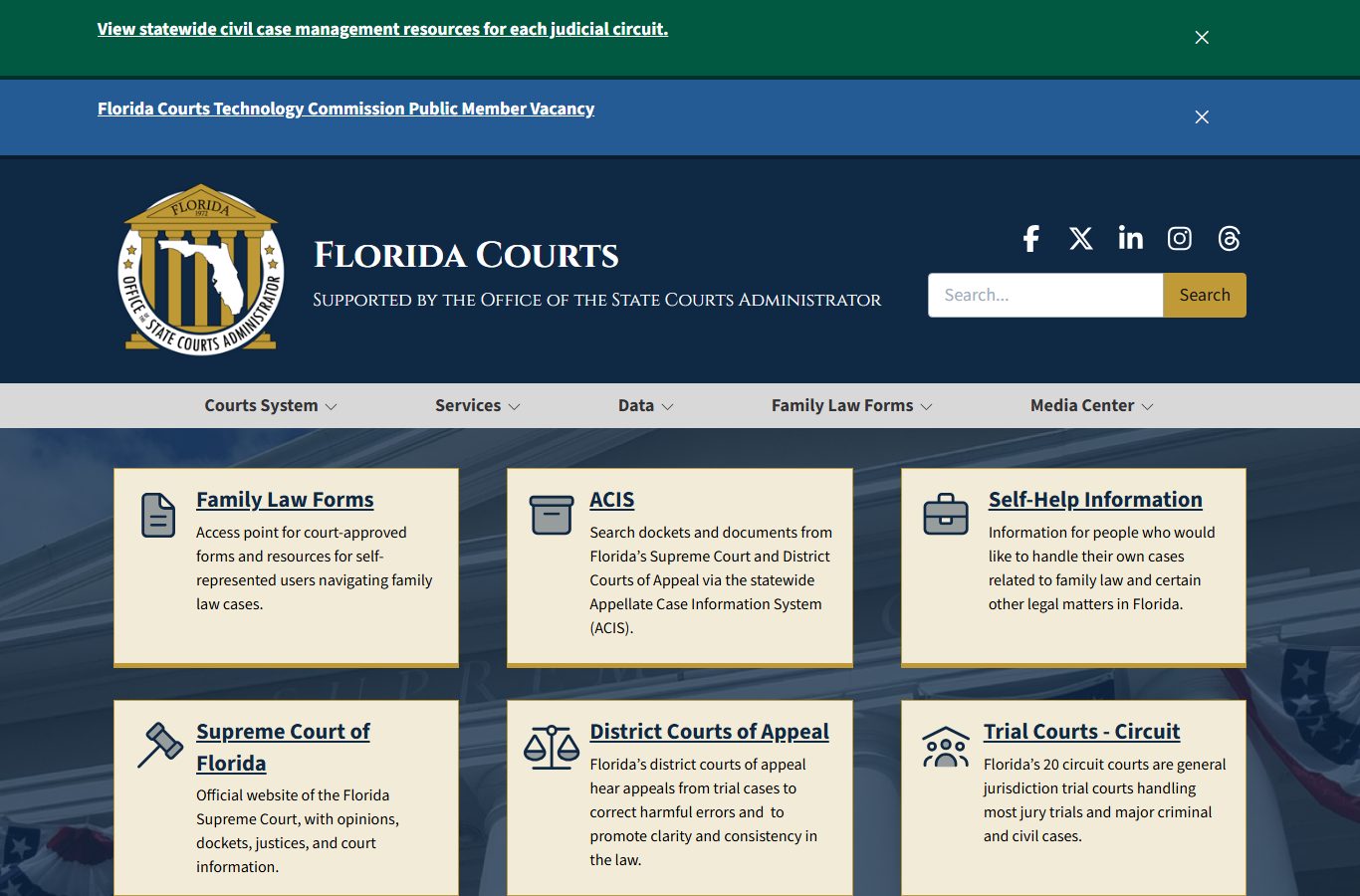
The Florida statewide courts portal, shown below, sets the rules every county clerk follows for electronic case access. You can see how the Florida Courts site ties the local Clerk's portal to the broader state system.
For a deeper walkthrough of each field, see the St. Johns County court records page.
The St. Johns County Judicial System
Florida uses a two-tier trial court system. The circuit court is the main trial court of general jurisdiction. It hears felonies, family cases, juvenile matters, probate, and larger civil disputes. The county court is the limited court, often called the people's court. It handles most misdemeanors, traffic, small claims, and county civil cases up to $50,000. St. Johns County sits in the Seventh Judicial Circuit along with Flagler, Putnam, and Volusia counties.
Above the trial courts sit the appellate courts. A party who loses can ask a District Court of Appeal to review the case, and the Supreme Court of Florida hears a narrow set of matters above that. Federal cases from the county go to the U.S. District Court for the Middle District of Florida, Jacksonville Division, not the local courthouse.
Case flow: County Court › Circuit Court › District Court of Appeal › Supreme Court of Florida
| Court | Jurisdiction | Case Types |
|---|---|---|
| County Court | Limited | Misdemeanors, traffic, small claims, county civil to $50,000. |
| Circuit Court | General | Felonies, family, juvenile, probate, civil over $50,000. |
| District Court of Appeal | Appellate | Review of trial court rulings. |
| Supreme Court of Florida | Highest state | Discretionary and assigned review. |
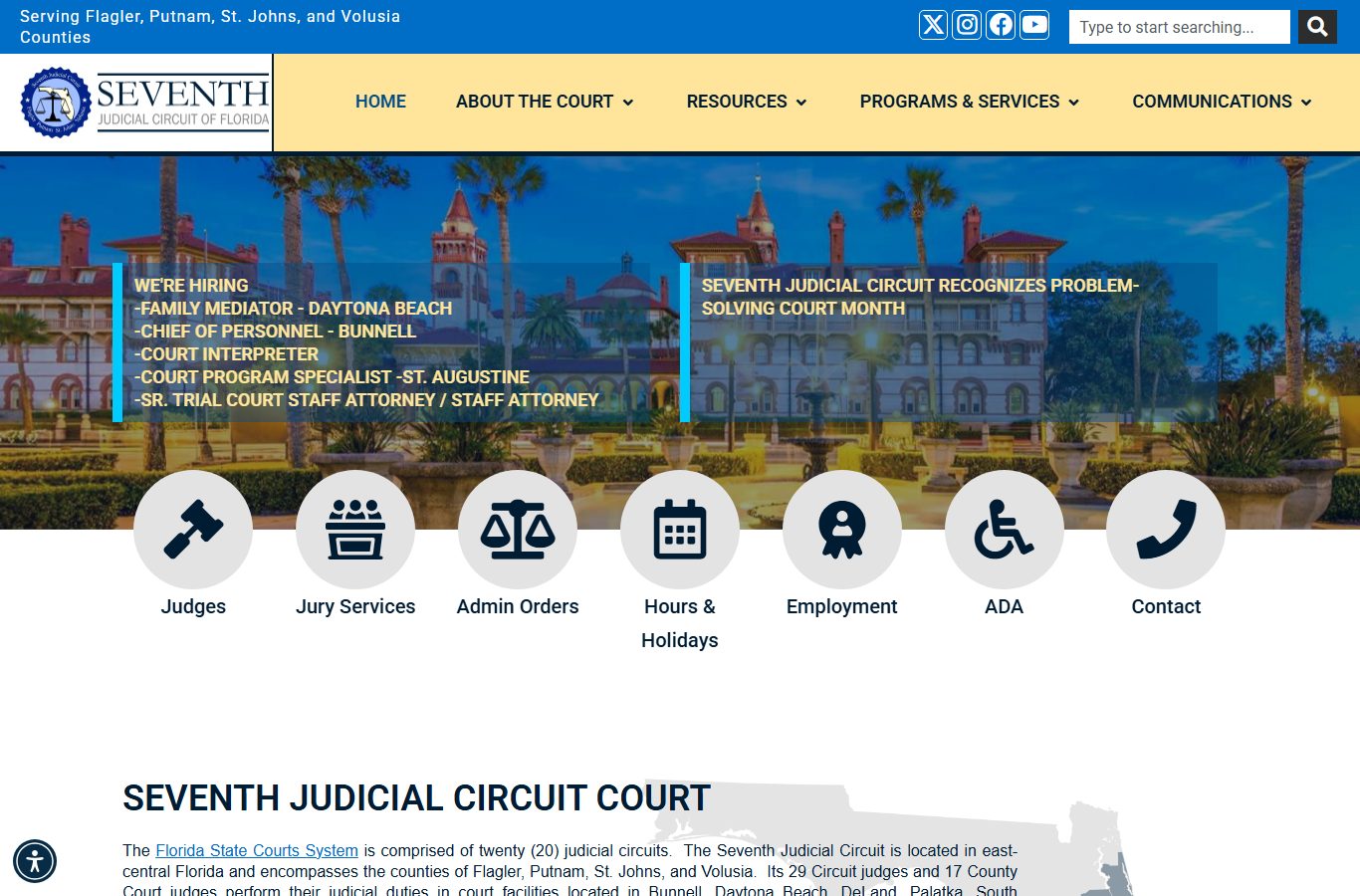
The Seventh Judicial Circuit runs court operations for all four counties. Its home page, shown below, lists judge counts and the courthouses it serves. You can confirm the circuit's reach on the Seventh Judicial Circuit site.
For the judge roster and court structure, see the Circuit Court and County Court pages.
St. Johns County Courthouses
The county's justice offices cluster on and near Lewis Speedway in St. Augustine. The courthouse, the Sheriff's Office, and the detention center sit close together but run as separate offices. The Clerk controls court files. The Sheriff runs the jail and serves warrants. Knowing which address you need saves a wasted trip, since the active courthouse is the modern judicial center, not the historic Old Jail downtown.
Richard O. Watson Judicial Center
4010 Lewis Speedway
St. Augustine, FL 32084
(904) 819-3600
St. Johns County Sheriff's Office
4015 Lewis Speedway
St. Augustine, FL 32084
(904) 824-8304
St. Johns County Detention Center
3955 Lewis Speedway
St. Augustine, FL 32084
(904) 209-3125
The Clerk's homepage, shown below, lists the courthouse address, phone, and hours in its footer. You can reach every Clerk service from the St. Johns County Clerk site.
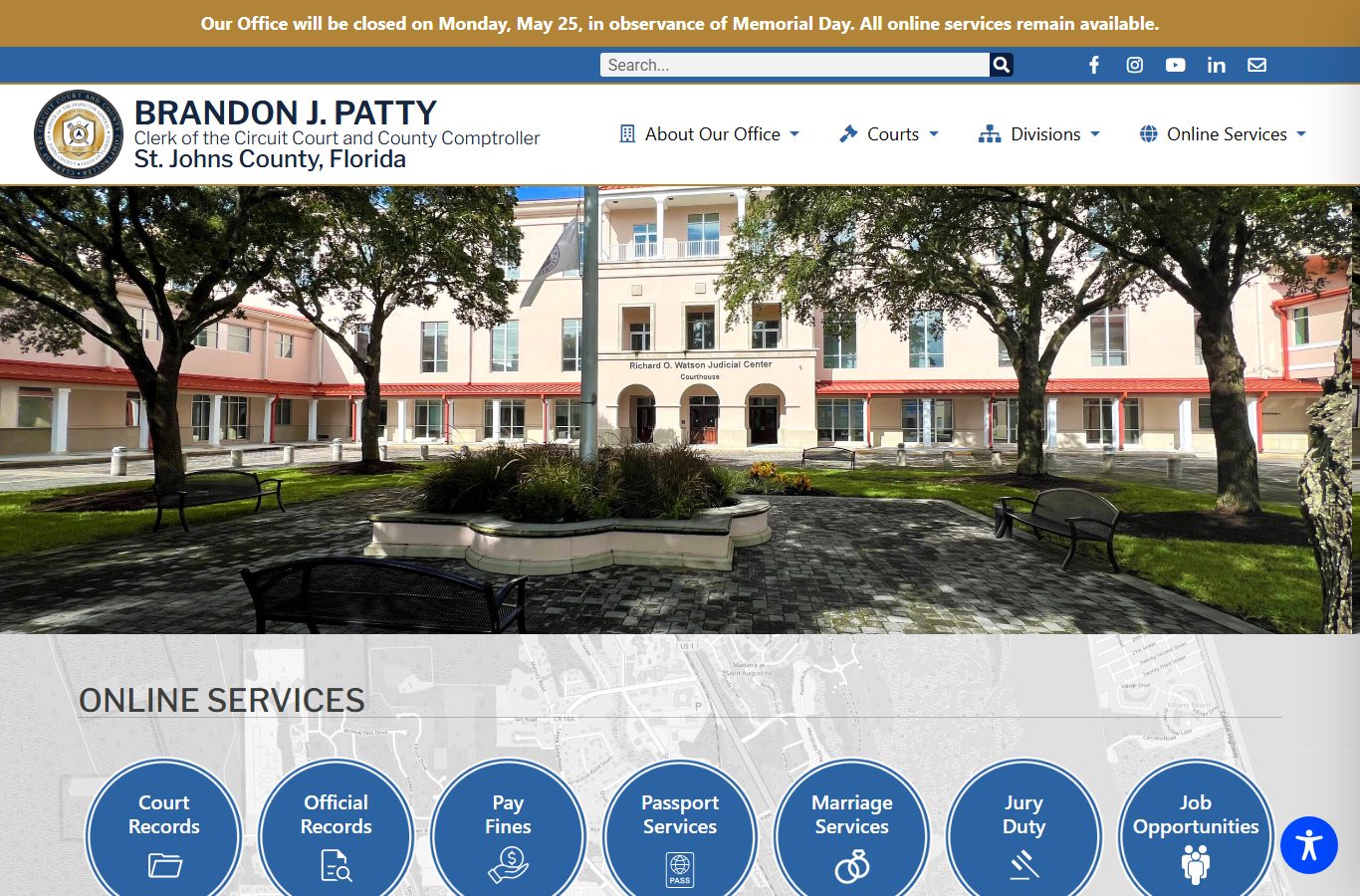
The courthouse was built in 1994 in a three-story pastel pink stucco style that fits the historic look of St. Augustine.
Types of Court Records Available in St. Johns County
The Clerk keeps records for every court division. Felony files are circuit court records. Most misdemeanors and traffic cases are county court records. Civil cases split by dollar amount. Family, probate, guardianship, and mental health matters each have their own category in the case search. Some files are open to anyone, while others are sealed or redacted by law.
Each division creates a different kind of record. The common groups you can find are listed below.
- Criminal records - felonies, misdemeanors, and criminal traffic with charges, pleas, and sentences.
- Civil records - circuit and county suits, foreclosures, evictions, and small claims.
- Family and divorce records - dissolution, support, paternity, name change, and injunctions.
- Probate records - estate administration, wills on deposit, guardianship, and incapacity.
- Traffic records - civil traffic infractions and citation cases.
What St. Johns County Court Records Show
A court record is a running file of every event in a case. The search result points you to the case, and the case detail lists the parties, the docket entries, and the outcome. Some documents can be viewed and printed free online. Certified copies come through E-Certify. The table below shows the main fields a public case record returns.
| Field | What It Shows |
|---|---|
| Case Number | The unique number used to pull the full file. |
| Court / Case Type | The division, such as felony, county civil, or family. |
| Parties | Plaintiff, defendant, petitioner, judge, and attorneys. |
| Charges / Cause | The statute, charge, or cause of action. |
| Disposition | The outcome, such as a judgment or dismissal. |
| Sentence / Judgment | Any penalty, award, or order entered. |
For a full field-by-field guide and a sample record layout, see the St. Johns County court dockets page.
Public Access Laws for St. Johns County Court Records
Florida starts from broad public access. Records are open for inspection and copying unless a clear exemption applies. The rule comes from article I, section 24 of the Florida Constitution and chapter 119, Florida Statutes. Court files also follow Florida Rule of General Practice and Judicial Administration 2.420 and Supreme Court access standards. You do not need to give a reason to view an ordinary public record.
Key Statutes:
Florida Statutes § 119.01 - sets the state's open records policy and the presumption of access.
Florida Statutes § 119.07 - covers inspection, copying, and the fees an office may charge.
Florida Statutes § 119.0714 - shields certain data in court files and official records.
For request steps, timelines, and fees, see the St. Johns County public records page.
Records That Are Restricted or Confidential
Access is broad, but it is not total. Juvenile justice records are confidential under Florida Statutes § 985.04. Adoption files are confidential under section 63.162, and mental health clinical records are protected under section 394.4615. Sealed criminal histories are restricted under section 943.059, and expunged records under section 943.0585. Some dismissed criminal cases become confidential after the Florida Department of Law Enforcement files an automatic sealing notice.
To view a sealed or confidential record, you usually need a court order or a legal exception. A person who wants their own record sealed or expunged starts with an FDLE eligibility review, then files a petition in the court that handled the case and pays the Clerk fee. Active warrants stay confidential until served. For more, see the criminal records and warrant records pages.
Specialty Courts in St. Johns County
The Seventh Judicial Circuit runs several problem-solving courts that focus on treatment and accountability instead of punishment alone. These include drug court, DUI court, and a Veterans Court that serves St. Johns and Putnam counties. The Veterans Court helps veterans in the justice system who face issues such as PTSD, brain injury, substance use, and the hard shift back to civilian life. It connects them to VA care, mental health and substance treatment, housing, and job support.
St. Johns County Veterans Court began in 2017 and had 122 graduates by a 2025 circuit celebration. With more than 23,000 veterans living in the county, the program fills a real local need. Eligibility depends on service verification, criminal history, and the offense, and the circuit, the State Attorney, the Public Defender, and the assigned judge all weigh in.
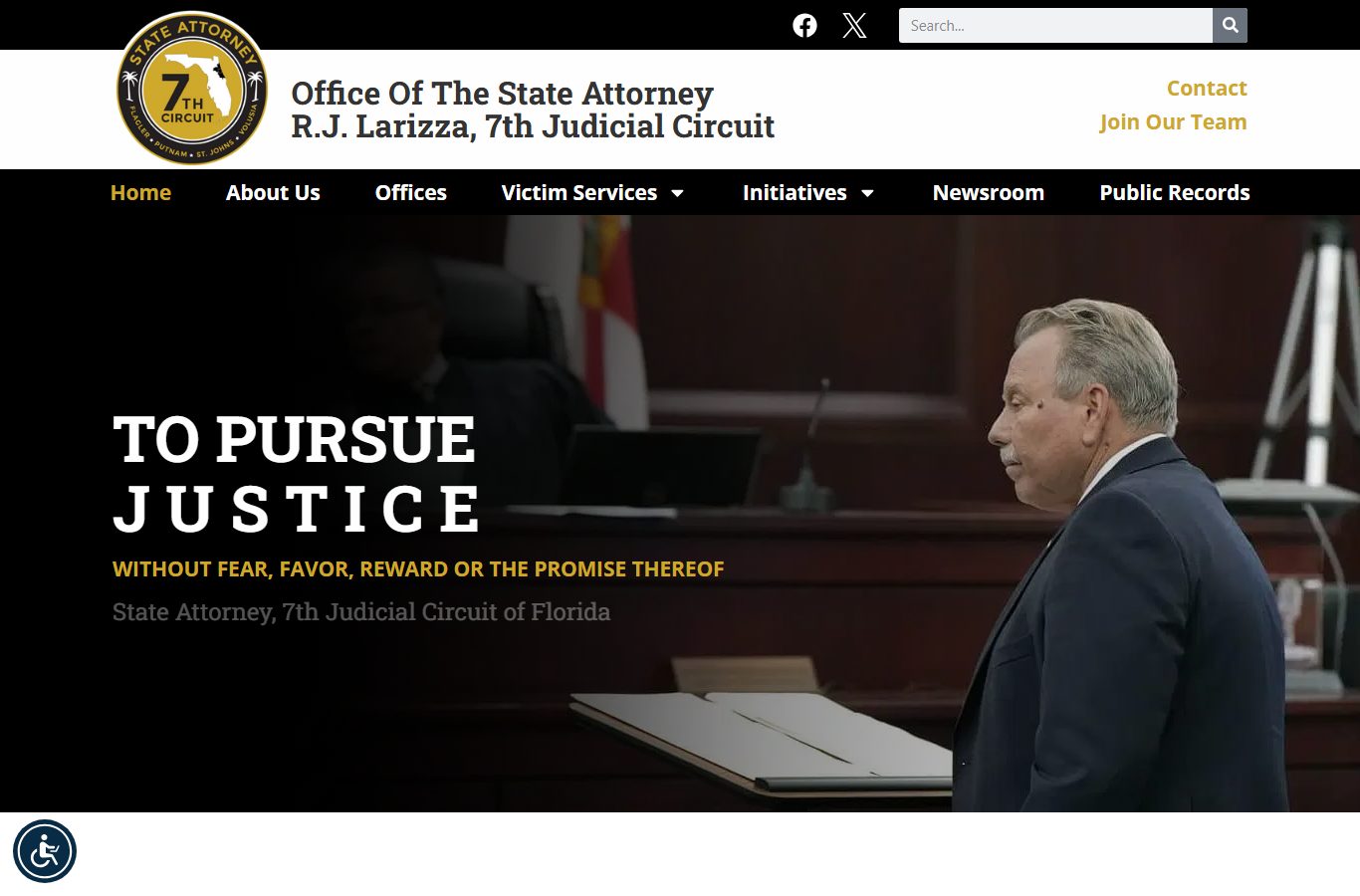
The State Attorney for the Seventh Judicial Circuit, R.J. Larizza, prosecutes cases across the four counties. The office homepage is shown below. You can read about its role and victim services on the State Attorney site.
The Public Defender, Matthew Metz, represents people who qualify for appointed counsel in the same four counties.
St. Johns County Sheriff and Jail
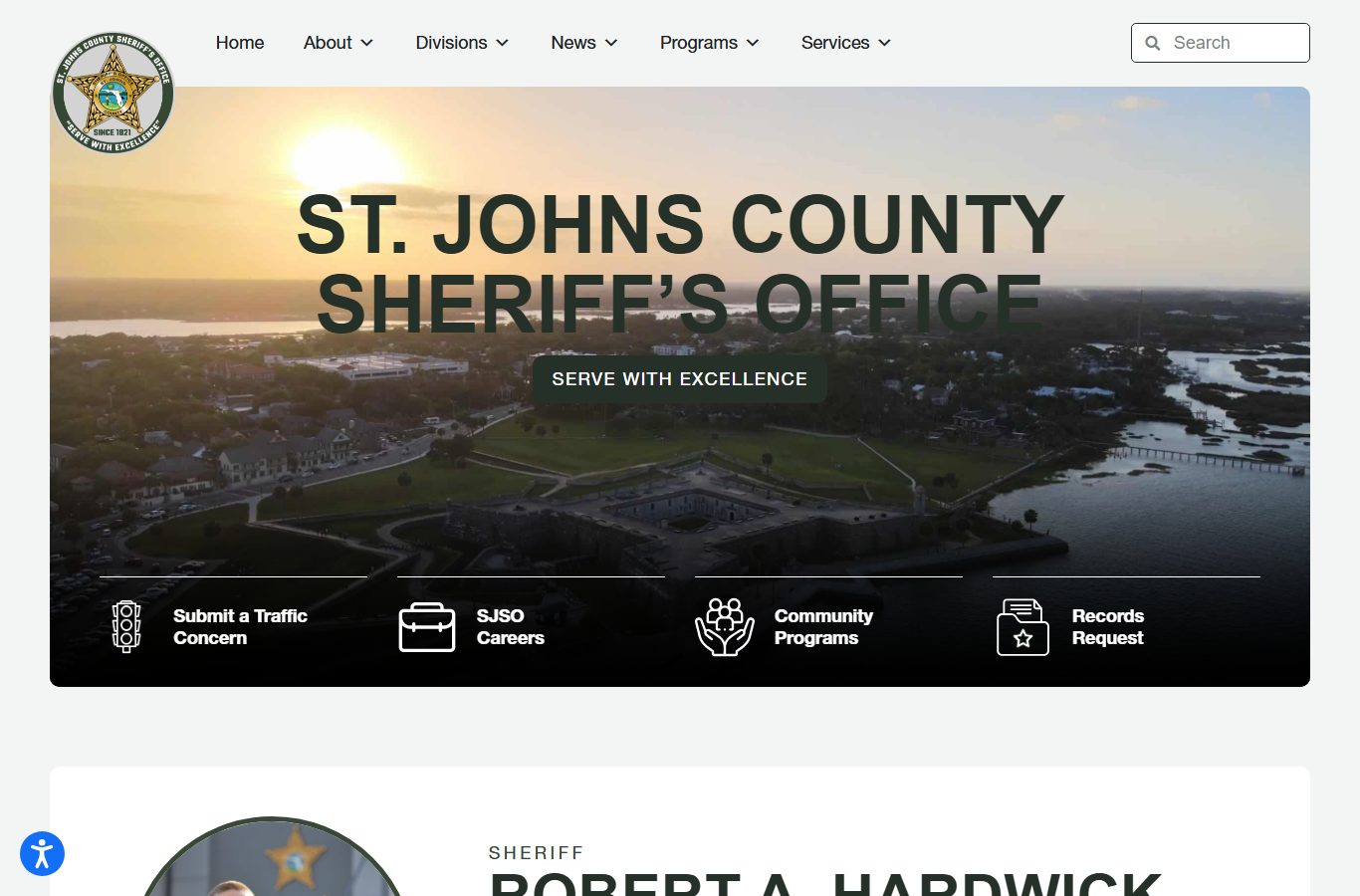
The St. Johns County Sheriff's Office, led by Sheriff Robert A. Hardwick, runs the county detention center at 3955 Lewis Speedway. The jail operates a Main Detention Unit for pre-trial and sentenced inmates and a Community Work Re-Entry Center for sentenced inmates. After an arrest, a person is booked, fingerprinted, photographed, and screened by a nurse. If they cannot bond out, they see a judge within 24 hours at first appearance.
The Sheriff's homepage, shown below, links to the official inmate search and jail resources. Start any custody check at the St. Johns County Sheriff's Office site rather than a third-party roster.
For the full roster guide see the St. Johns County inmate records page, for release help see released inmates, and for active warrants see warrant records.
Marriage, Divorce, and Probate Records
The Clerk also handles marriage licenses, divorce case files, and probate. A Florida marriage license is valid statewide for 60 days. Divorce is called dissolution of marriage and is a family court record searched in Benchmark. Probate runs through the Clerk and the probate division of the circuit court. For details, see the marriage and divorce records and probate records pages.
- Testator
- The person who makes a will to direct how property passes at death.
- Executor
- In Florida, the personal representative who settles the estate under court supervision.
- Conservator
- A person appointed to manage the affairs of someone who cannot manage their own.
St. Johns County Court Records Fees
The Clerk charges set fees for copies and certifications. Plain court record copies run per page. A certification adds a flat fee per document. A name search without a case number carries a small per name, per year charge. Card payments add a convenience fee. The table below lists the common charges.
| Item | Amount |
|---|---|
| Court record copy, per page | $1.00 |
| Certification of a document | $2.00 |
| Name search, per name and per year | $2.00 |
| Seal or expunge a record | $54.00 |
| Credit or debit card convenience fee | 3.5% |
The full schedule, including marriage and driver record fees, is on the Clerk of the Circuit Court page.
How to Interpret St. Johns County Court Records
Court files use terms that can confuse a first-time reader. A charge is only an accusation. A conviction means a court found guilt or entered an adjudication. A case marked open or pending has not reached a final outcome. A closed or disposed case has a judgment, sentence, or dismissal on file. Dismissed means a charge or claim ended without a finding, and some dismissed criminal cases later become confidential.
Other common words help you read a docket. A motion is a request to the judge. An order is the judge's written decision. A capias is a Florida arrest writ, often issued after a missed court date. When in doubt, the Clerk can confirm what a code or entry means, though staff cannot give legal advice.
Legal Aid and Self-Help in St. Johns County
People who cannot afford a lawyer have local options. St. Johns County Legal Aid, run through Jacksonville Area Legal Aid, helps low-income, elderly, and disabled residents with civil matters. The office is at 222 San Marco Avenue in St. Augustine and can be reached at (904) 827-9921. For criminal cases, the Seventh Circuit Public Defender represents those who qualify.
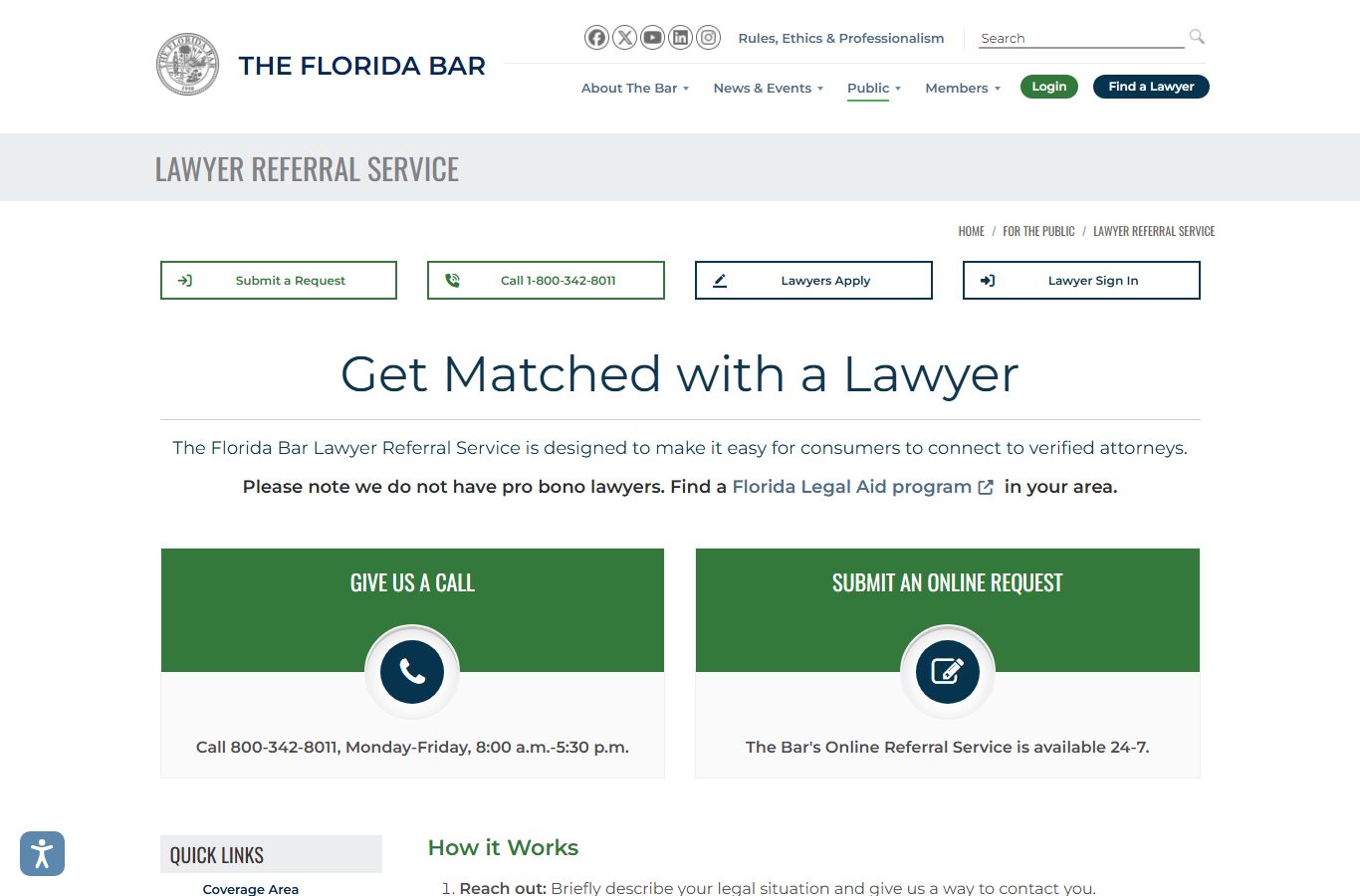
If you need a private attorney, the Florida Bar Lawyer Referral Service can match you with one. Its page is shown below, and it offers a short first consultation for a small fee. You can request a referral on the Florida Bar Lawyer Referral Service site.
The Clerk's forms library also supports self-represented filers in small claims, eviction, family, traffic, and probate matters.
Accuracy and Record Limitations
Online court records are useful, but they are not flawless. The case search updates in real time, yet a new filing can take a short while to post, and some documents are redacted or withheld. A driver record kept by the state is separate from the court traffic file and may update on its own schedule.
Note: Always confirm a court fact, fee, or hearing date with the Clerk at (904) 819-3600 before you rely on it for a legal step.
History of St. Johns County Courts
St. Johns County is one of Florida's oldest counties, set up on July 21, 1821, soon after Florida came under U.S. control. St. Augustine, the county seat, was founded in 1565 and is the oldest continuously occupied European-founded city in the country. Florida's modern two-tier trial court system traces to the 1972 Article V revisions that created today's circuit and county courts.
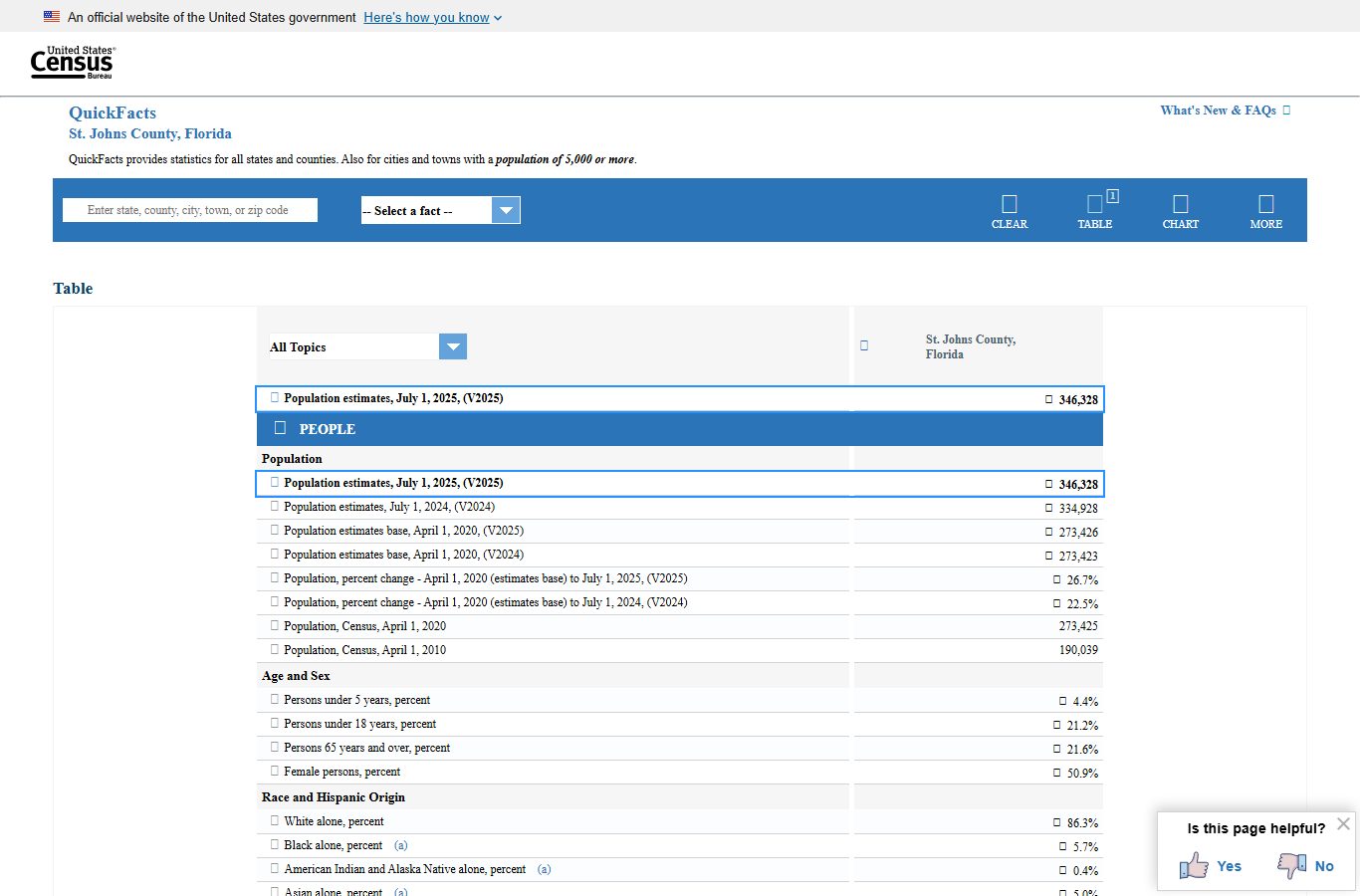
The county's rapid growth shapes its courts. Census figures, shown below, put the population near 346,000 in 2025, up sharply from the 2020 count. That growth helps explain rising demand for traffic, housing, and family cases. You can review the local numbers on the Census QuickFacts page.
The current Richard O. Watson Judicial Center opened in 1994 and replaced older courthouse arrangements.
Federal Court Records for St. Johns County
Some cases are not state matters at all. Federal crimes, bankruptcy, and suits under federal law go to the U.S. District Court for the Middle District of Florida, and St. Johns County falls in its Jacksonville Division. The federal courthouse sits in Jacksonville, not St. Augustine. Official federal records are searched through PACER, with CM/ECF as the filing system.
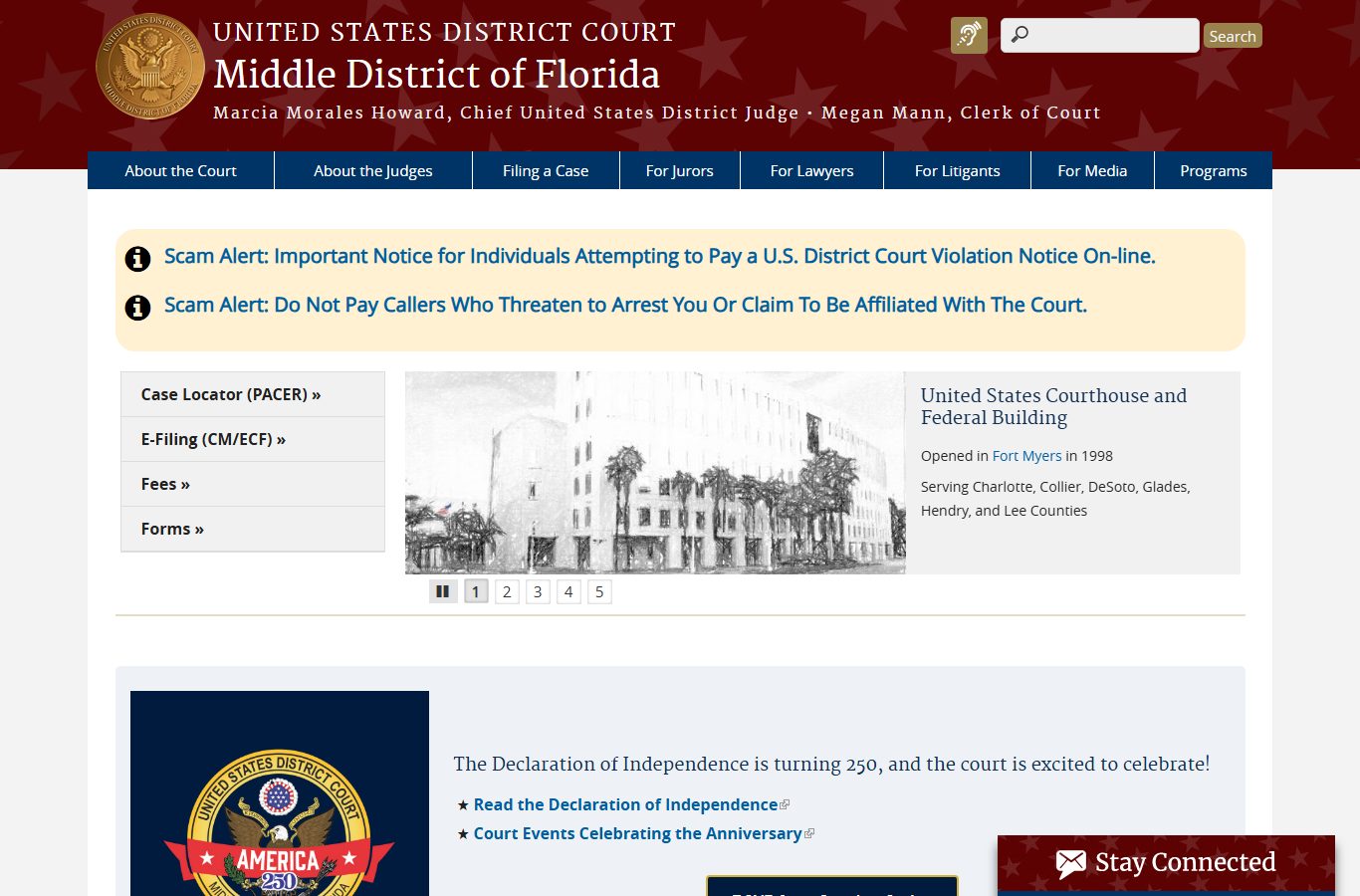
The Middle District's site, shown below, lists its divisions and the counties each one serves. You can confirm the division map on the U.S. District Court, Middle District of Florida site.
Bankruptcy is handled separately by the U.S. Bankruptcy Court for the Middle District of Florida.
Frequently Asked Questions
How do I search St. Johns County court records online?
Use the Clerk's online research page and choose Court Records to open the Benchmark portal. You can search by name, case number, citation, date, court type, party, and statute. If you know the case number, use it first because it avoids common-name problems. Recorded documents like deeds and marriage licenses are searched in the separate Landmark official records system.
Are St. Johns County court records updated in real time?
Yes. The Clerk says the court search is real time, so it reflects records as the system has them. That does not mean every document is open. Sealed, juvenile, expunged, and active warrant records may be withheld or redacted. If a filing seems missing, call the right Clerk division or file a public records request.
Does the Clerk publish active warrants?
No. The Clerk does not publish active warrant information. Warrants and supporting affidavits stay confidential until served. For warrant questions, call the Sheriff's Office at (904) 209-1440. After a warrant is served, related documents may appear inside the individual court case.
More on the St. Johns County Court Records FAQ page.