
Florida Public Records Law and St. Johns County
Florida's public records framework begins with the state constitution. Article I, section 24 of the Florida Constitution guarantees the right of every person to inspect or copy any public record. Chapter 119, Florida Statutes, implements that right through specific rules on agency obligations, copying fees, and exemptions. Florida Statutes § 119.01 sets the general state policy, declaring that it is the policy of Florida that all state, county, and municipal records are open for personal inspection and copying. No special reason or stated purpose is needed to request ordinary public records. You simply ask, and the agency must respond promptly.
Courts are also subject to additional rules specific to judicial branch records. Florida Rule of General Practice and Judicial Administration 2.420 and the Florida Supreme Court's electronic access standards govern what portions of court files are visible to the public, which portions require registration, and what is confidential regardless of the chapter 119 rules. For St. Johns County users, this means the Clerk's Benchmark portal may show some documents while withholding others in the same case based on the access level of the person viewing them.
The Clerk's public records page at stjohnsclerk.com/recording/public-records is the official starting point for requests. The Clerk recommends searching Court Records, Official Records, or Board Records online before submitting a formal written request, because many records are already available at no cost through those portals.
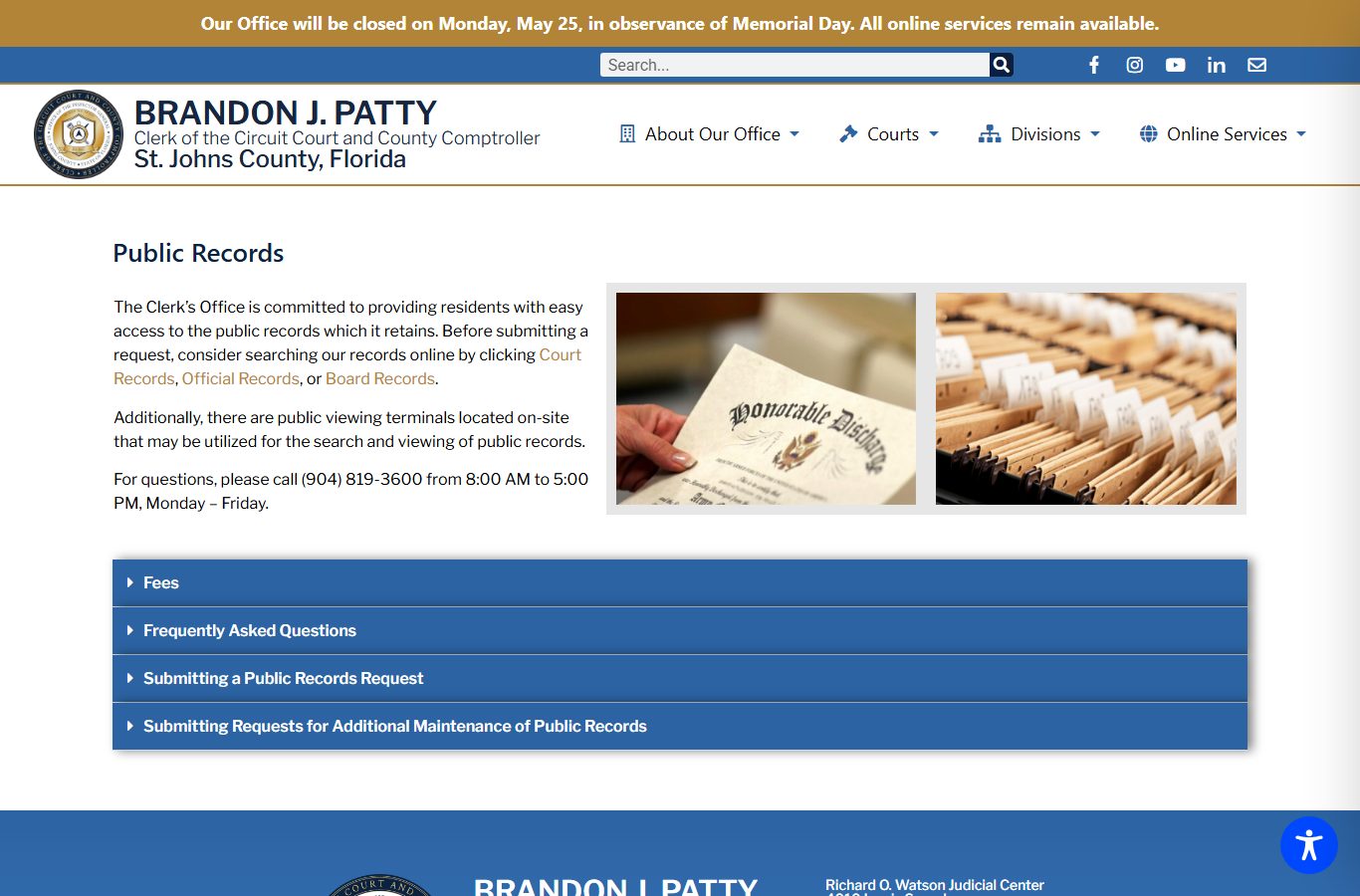
The Clerk's public records page lists fees, request methods, payment options, and answers to common questions about dismissed cases, warrant records, and what the Clerk does and does not hold.
The St. Johns County Public Records Request Portal
On January 6, 2025, the St. Johns County Clerk launched a new online public records request portal. The announcement at stjohnsclerk.com describes the portal as a way for residents to submit and track records requests entirely online. When a request is submitted through the portal, the system generates a unique identifier number and a security key. Those two pieces let the requester check the status of their request without having to log in or create an account. Anonymous tracking is built in.
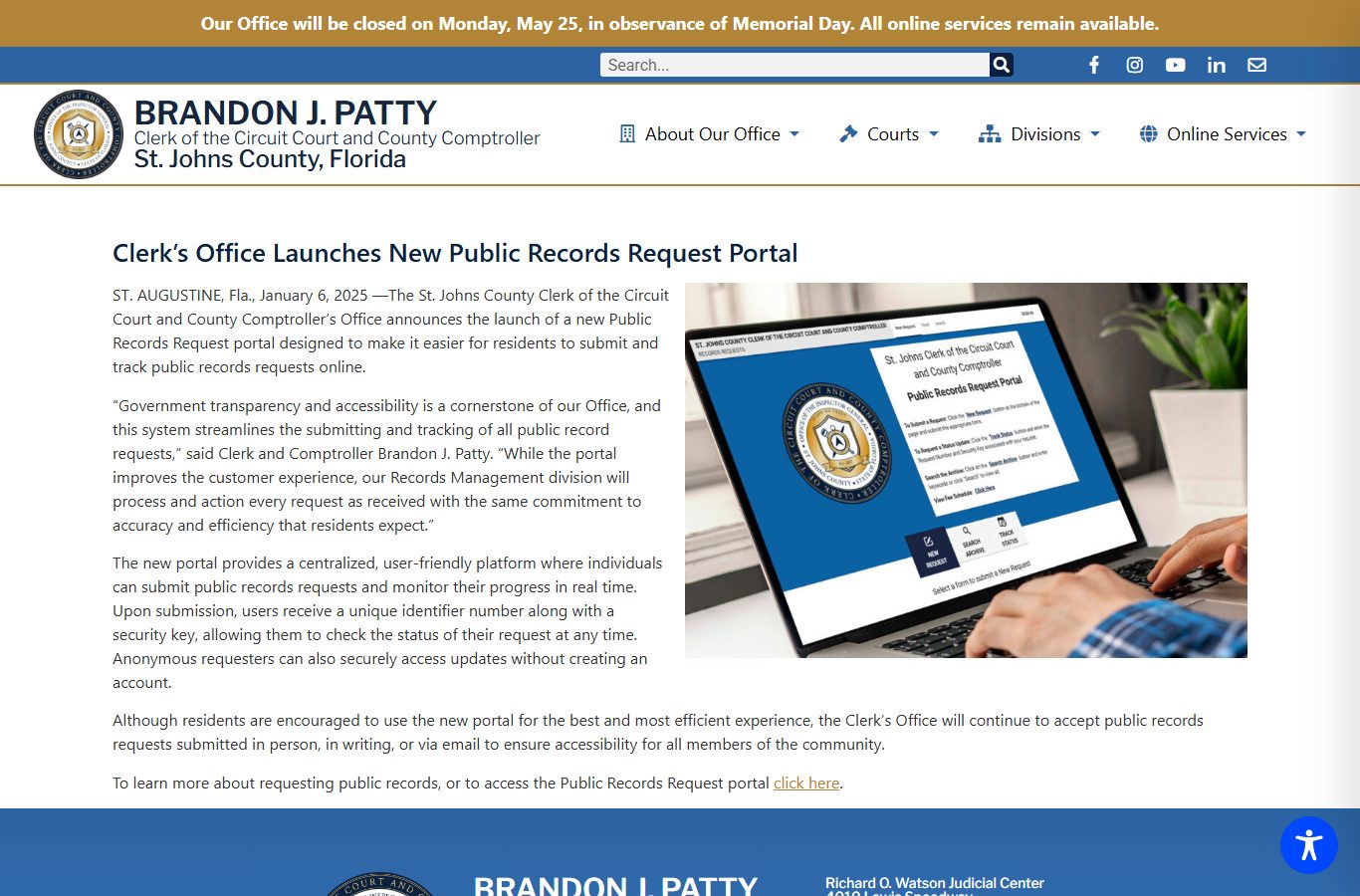
The January 2025 announcement explains how the portal works, what the unique identifier and security key do, and how requesters can track their request at any point without creating an account.
The Clerk still accepts requests by other methods. You can submit in person at the main office, in writing by mail, or by email to PRR@stjohnsclerk.com. The Clerk says the office is committed to providing easy access to public records and encourages users to search existing online databases first. That search step often eliminates the need to submit any formal request.
Public access terminals are available on-site at the courthouse for users who prefer to view records in person without making a copy request. Staff can direct you to the nearest terminal. The Clerk's main phone number for public records inquiries is (904) 819-3600, available Monday through Friday from 8:00 AM to 5:00 PM.
What Records the St. Johns County Clerk Maintains
The Clerk of the Circuit Court and County Comptroller is a unified constitutional officer who holds both court records and official records for St. Johns County. The office does not just keep court case files. It also records and maintains a wide range of non-court instruments and county-level records. Knowing which system holds the record you need saves time and avoids unnecessary requests.
- Court records - criminal, civil, family, probate, guardianship, traffic, and other case files from circuit and county courts; searchable in Benchmark.
- Official records - recorded instruments including deeds, mortgages, liens, recorded marriage licenses, plats, and notices; searchable in Landmark.
- Board records - County Commission minutes, resolutions, and related county board materials; linked from the Clerk's online research hub.
- Tax deed records - tax deed sale files; searchable in TaxSmart.
- Marriage licenses - issued and recorded by the Clerk; appears in Official Records after recording.
- E-filing records - documents filed through the Florida Courts E-Filing Portal appear in the Benchmark case records once processed.
Records that are not held by the Clerk include arrest records held exclusively by the Sheriff's Office, driver records held by FLHSMV, state criminal history held by FDLE, and federal court records accessible through PACER. Each agency responds to records requests for its own documents.
Modern Records vs. Archival Records
The Clerk divides records into two broad categories based on age. Modern Era Records cover roughly the 1990s to the present day. Most publicly disclosable modern court and official records are available through the Benchmark and Landmark online portals at no charge. You can search by name, case number, date, or document type and view most case data without registering. Some documents within a modern case may require registration or a direct copy request based on the type of case or the access level of the viewer.
Archival Records cover 1821, when Florida became a U.S. territory, through roughly the early 1990s. St. Johns County is one of Florida's oldest counties, established in 1821 when Florida came under U.S. control. The county has nearly 200 years of court records, many of which have been digitized but are not available for remote online review. Digital scans of archival records can be accessed on-site at public terminals at the Clerk's office. You can also request archival records through a formal public records request submitted by mail, email, or in person. Processing time may be longer for archival materials because they may require physical retrieval or specialized scanning.
How to File a Public Records Request in St. Johns County
Submitting a public records request is straightforward. The Clerk does not require you to use a specific form, though using the online portal makes tracking easier. The key is to describe the records you want as clearly and specifically as possible. Vague requests may slow the response or result in a clarifying question from the Clerk. If you know the case number, record date, party name, or document type, include all of it.
- Search the Clerk's free online portals first. Check Benchmark for court records and Landmark for official records. Board Records are also linked from the research hub. If you find the record online, no request is needed.
- If the record is not available online, decide how to submit. Options are: online portal at stjohnsclerk.com/recording/public-records; email to PRR@stjohnsclerk.com; in-person visit to 4010 Lewis Speedway, St. Augustine, FL 32084; or written mail to the same address.
- Describe the records you want. Include both parties' names or the decedent's name, the case number if known, the approximate date range, and the type of document (final judgment, deed, booking photo, etc.). The more specific you are, the faster the Clerk can locate and produce the records.
- State your preferred format. If you want digital copies, say so. If you need certified copies, note that separately because certification adds a fee per document.
- Wait for the Clerk's response. Florida law requires agencies to respond promptly. If the Clerk needs additional time to gather records, it should notify you. If records are being withheld under an exemption, the Clerk should identify the exemption.
- Pay the applicable fees. The Clerk will tell you the cost before producing copies that carry a charge. Pay by cash (in person only), personal check, money order, or credit/debit card (with 3.5% convenience fee). Once payment is made, the Clerk provides the records.
What to Include in Your St. Johns County Records Request
The table below summarizes the information the Clerk finds most useful for locating and producing records quickly. None of these fields are mandatory by law, but providing more detail reduces back-and-forth and speeds up the process.
| Field / Item | Required by Law | Notes |
|---|---|---|
| Your name and contact information | No | You can submit anonymously, but providing contact info allows the Clerk to follow up with questions or cost estimates. |
| Description of records requested | Yes (must describe the records) | Be as specific as possible. Include names, dates, case numbers, or document types. |
| Date range | No | Helps narrow a search, especially for archived or voluminous records. |
| Case number or clerk file number | No | Using a case number is the fastest path for court records or official records. |
| Preferred format (paper, electronic, certified) | No | Stating your format preference helps the Clerk calculate costs in advance. |
| Purpose of the request | No | You are not required to state a purpose for ordinary public records. Do not let an agency demand a reason as a condition of access. |
If you submit by email to PRR@stjohnsclerk.com, keep in mind that your email address is itself a public record under Florida law because it is submitted to a public agency.
Public Records Fees in St. Johns County
Florida Statutes § 119.07 sets the fee framework for public records. Agencies may charge only the actual cost of duplication for standard-size documents. The Clerk's fee schedule at stjohnsclerk.com/clerks-fees-2 lists the specific charges for the records it maintains. The table below covers the main fees for public records and court records requests.
| Item | Fee |
|---|---|
| Photocopies of non-BCC public records including court records, per page | $1.00 |
| Certification of a non-BCC document including court records | $2.00 |
| BCC records photocopies maintained by Clerk, per page | $0.15 |
| Certified copy of BCC records maintained by Clerk | $1.00 |
| Name search, per name and per year (no case number) | $2.00 |
| Clerk letterhead statement on search results | $7.00 |
| Certificate of exemplification or authentication | $7.00 |
| Credit or debit card convenience fee | 3.5% |
Payment options for records requests: cash is accepted in person only. Personal checks, money orders, and cashier's checks should be made payable to the St. Johns County Clerk's Office. Credit and debit cards (Visa, MasterCard, American Express) are accepted in person and by phone with the 3.5% convenience fee applied.
The relevant statute for inspection and copying fees is Florida Statutes § 119.07, which governs how agencies respond to requests and what they may charge for copies.
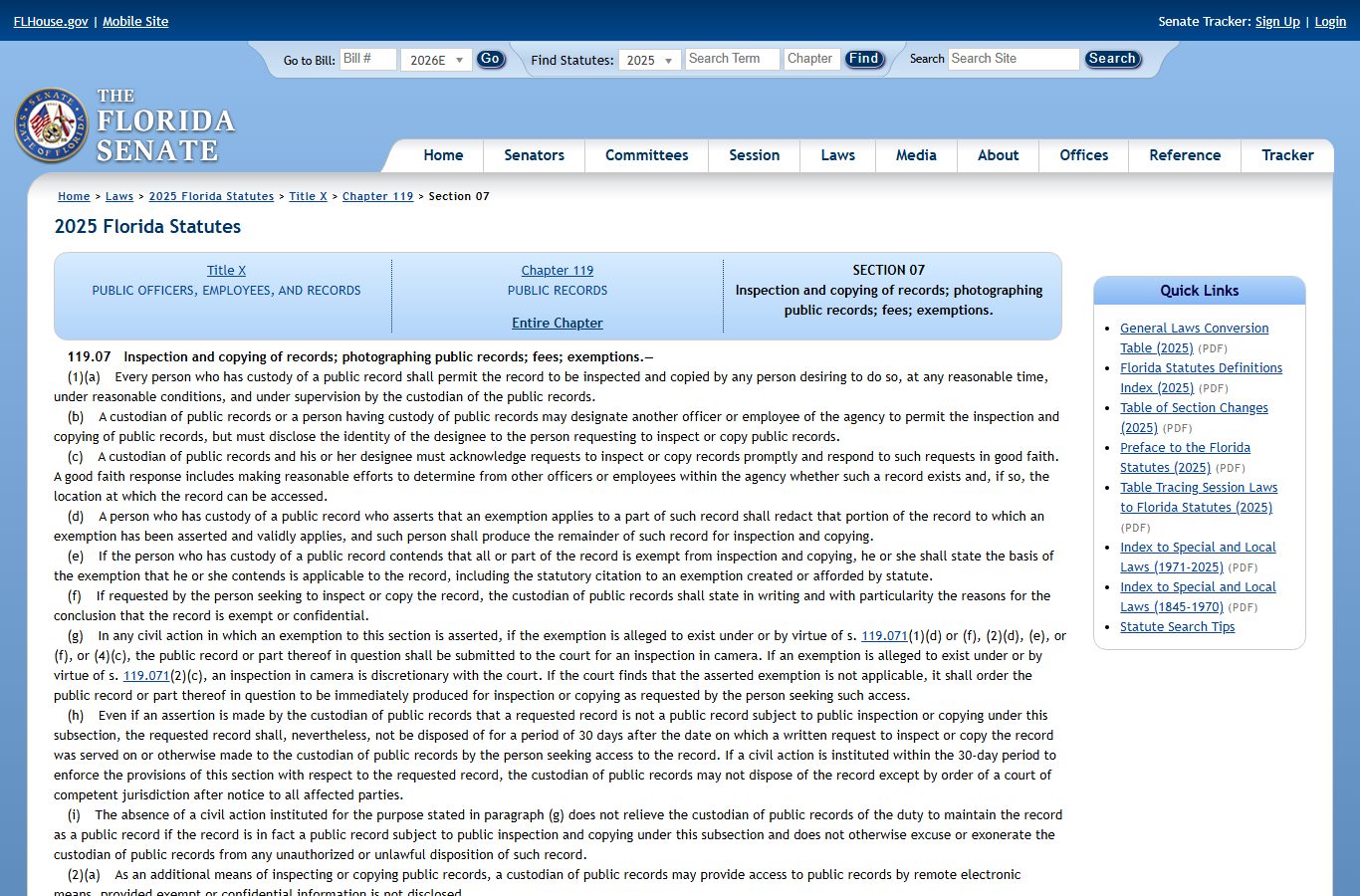
Section 119.07 sets the inspection and copying rules that the St. Johns County Clerk and all other Florida agencies must follow when responding to public records requests.
Electronic Official Records and Identity Protections
The Landmark Official Records portal makes recorded instruments accessible online for anyone. Deeds, mortgages, recorded marriage licenses, liens, and other recorded instruments can be searched by name, document type, date, or book and page. Florida Statutes § 28.2221 governs electronic access to official records and addresses identity-theft protections for information posted online. The statute recognizes the value of online access while setting rules for how personal identifying information such as Social Security numbers and financial account numbers is handled in publicly posted records.
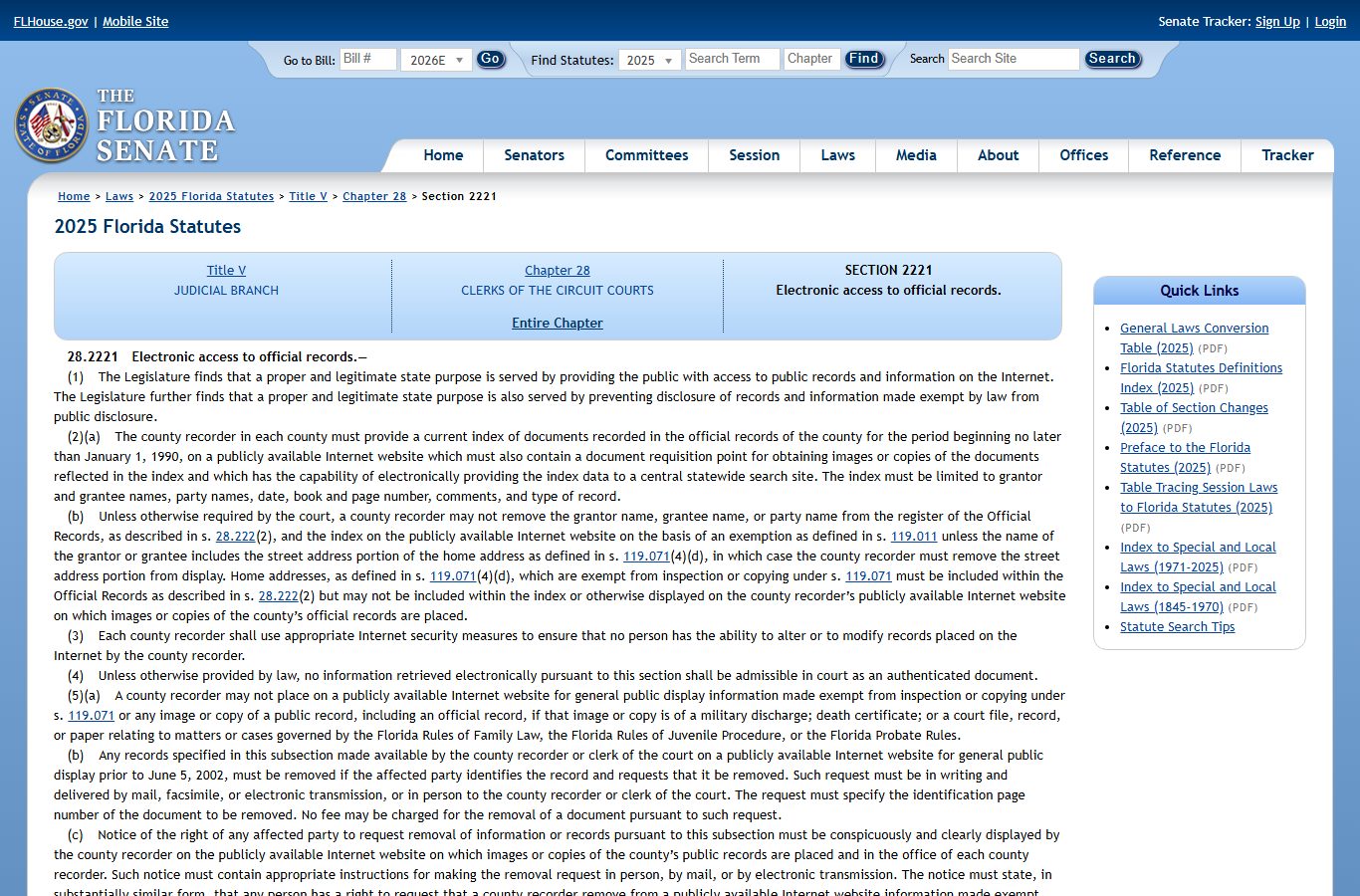
Section 28.2221 supports the Landmark portal's accessibility while requiring that certain personal information, particularly Social Security numbers and financial account numbers, be redacted or protected from online posting.
The Landmark portal opens with a disclaimer requiring users to accept the terms before searching. The Recording Division notes that it provides the information as a public service, makes no warranty on completeness or accuracy, and advises users to search all spelling variations of proper names because name-matching in older records is imperfect.
Records That Are Exempt or Confidential
Not every government record is public. Florida Statutes § 119.071 contains many general exemptions covering law enforcement investigative materials, personal safety information, protected personal identifying data, trade secrets, and other categories. Florida Statutes § 119.0714 specifically addresses court files, court records, and official records exemptions, which is why some data in a court case is redacted or withheld even from online anonymous viewing.
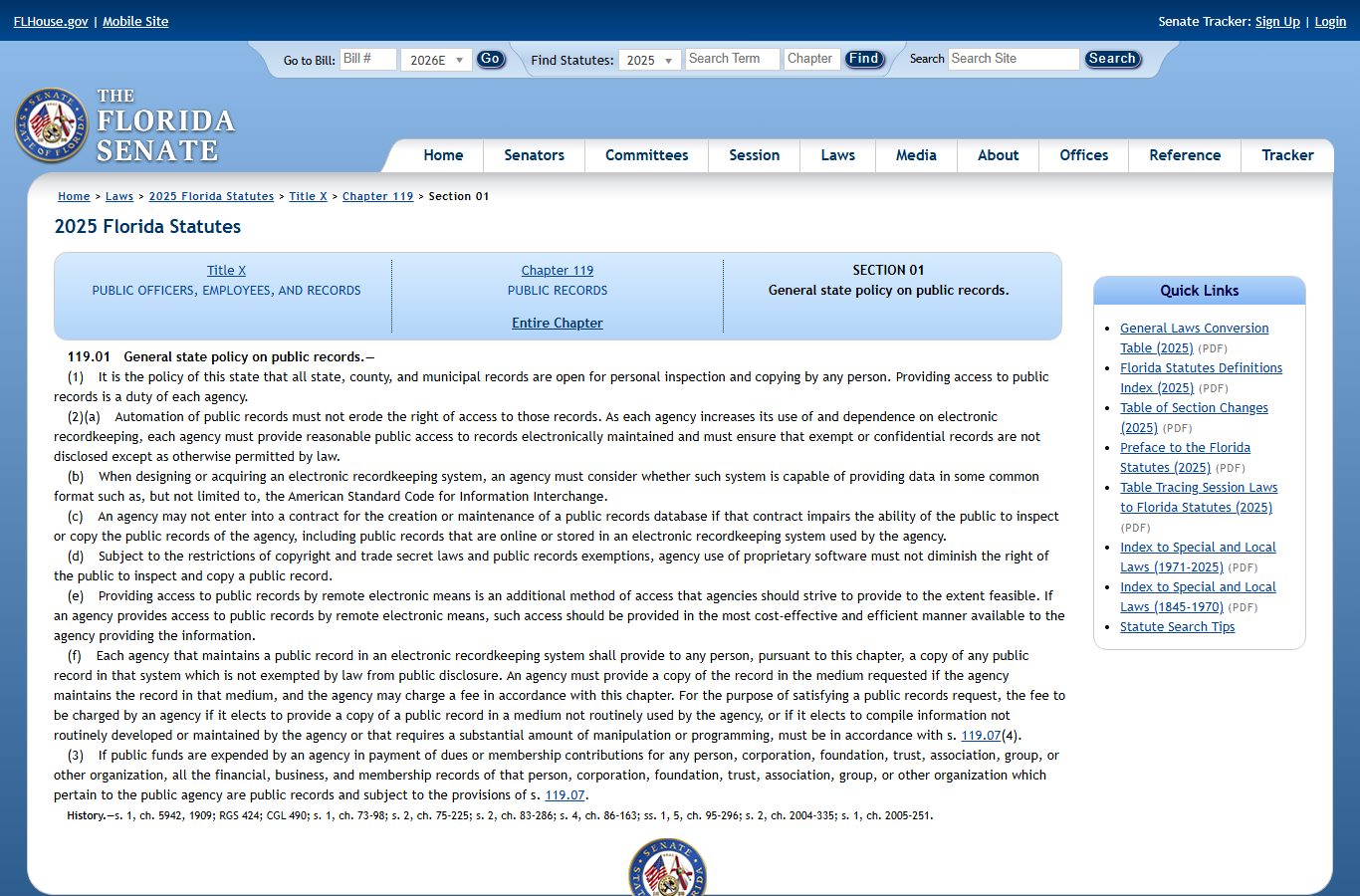
Section 119.01 sets the broad public access policy that governs the Clerk and all other St. Johns County agencies, while subsequent sections in chapter 119 define the limited categories of records that are exempt from that general rule.
Common categories of restricted records in St. Johns County include juvenile justice records, sealed and expunged criminal history, active warrant affidavits, adoption files, mental health clinical records, domestic violence victim information, protected personal addresses, and attorney-client privileged material. If the Clerk withholds a record or portion of a record, it should cite the applicable exemption so you can evaluate whether it applies to your request. If you believe the exemption is wrong, you can seek legal advice or pursue a court action under chapter 119 to compel access.