
How to Look Up St. Johns County Jail Population Data
The St. Johns County Sheriff's Office publishes annual reports that contain detention statistics such as bookings, average daily population, and accreditation data. The SJSO annual reports page at sjso.org/annual_reports provides links to report PDFs for multiple years. These PDFs are the primary official source for county-specific jail counts and trends. The online SJSO website does not display a real-time population dashboard; the data lives in the downloadable annual reports.
For those who cannot access the annual reports or need comparative data, the Bureau of Justice Statistics at bjs.ojp.gov publishes the Annual Survey of Jails and related reports. BJS collects data from county jails nationwide, including Florida, and publishes aggregate and county-level figures in its jail census and survey series. These are research-institute figures, not official SJSO counts, but they are grounded in data reported by the agency itself to the federal government. Vera Institute's Incarceration Trends tool at incarcerationtrends.vera.org translates BJS and Census data into county-level charts and comparisons that are easier to navigate than raw BJS files. Both are labeled clearly as research-institute products; they are useful context but not substitutes for SJSO-issued official data.
St. Johns County Jail Capacity Overview
The St. Johns County Detention Center operates two distinct units within the 3955 Lewis Speedway complex in St. Augustine. The 2025 SJSO inmate handbook, revised February 7, 2025, confirms both units and their functions. The Main Detention Unit holds pre-trial inmates, sentenced inmates, and direct-filed juveniles. The Community Work Re-Entry Center holds sentenced inmates who participate in the work re-entry program. These are functionally different units with separate inmate populations, though both fall under the same detention administration led by Director of Corrections Jason M. Caban.
Rated capacity for either unit was not found in the official SJSO web pages and FAQ reviewed during research. The table below reflects that gap honestly. To obtain current capacity figures, check the most recent SJSO annual report PDF or contact the SJSO at (904) 824-8304.
| Facility | Function | Rated Capacity | Source Note |
|---|---|---|---|
| Main Detention Unit | Pre-trial, sentenced, direct-filed juveniles | Not published in official sources reviewed | 2025 SJSO inmate handbook confirms function only. |
| Community Work Re-Entry Center | Sentenced inmates / work re-entry | Not published in official sources reviewed | 2025 SJSO inmate handbook confirms function only. |
National context: the Bureau of Justice Statistics 2019 Census of Jails found that U.S. county and municipal jails collectively held about 734,000 people on a given day. Smaller to mid-sized Florida counties vary widely in capacity, ranging from a few hundred beds to several thousand. St. Johns County's population grew 26.7% from the 2020 Census to a 2025 estimate of 346,328 residents, according to U.S. Census QuickFacts. Rapidly growing counties sometimes face jail capacity pressure as arrest rates rise alongside population. Whether St. Johns has experienced that pressure is a question the SJSO annual reports would answer with booking trend data.
Average Daily Population at the St. Johns County Jail
Average daily population, or ADP, is the standard metric jails use to track how many people are held on a typical day. It smooths out day-to-day variation caused by bookings, releases, and transfers and gives a more stable picture than a point-in-time snapshot. ADP figures for the St. Johns County Detention Center were not published on the SJSO website pages reviewed. Official ADP data is reported by SJSO to the Bureau of Justice Statistics as part of the Annual Survey of Jails and appears in BJS reports; look for the most recent BJS jail report at bjs.ojp.gov and search for Florida county-level tables.
For year-over-year comparison, the Vera Institute Incarceration Trends tool at incarcerationtrends.vera.org charts ADP over time using the same BJS-sourced data. Vera labels this data as coming from BJS survey filings, not from county-issued press releases. If the SJSO annual reports are available, they may contain booking totals and average population figures that are more current than the federal survey cycle, which typically lags by one to two years.
Note: Any ADP figures from BJS or Vera should be cited as research-institute data sourced from agency survey responses, not as current official SJSO counts. Conditions can change between the survey year and publication.
Demographic Breakdown of the St. Johns County Jail Population
Demographic data for the St. Johns County jail, including gender, race, and age distributions, was not published on the SJSO website pages and FAQ reviewed during research. This type of breakdown is typically included in SJSO annual reports and in BJS jail census data. The information below uses national and state context from BJS and Vera to frame what research institutes find for county jails broadly.
Nationally, BJS data from recent jail censuses shows that roughly 85% of jail inmates are male and 15% are female. Racial and ethnic compositions vary significantly by county. Florida's incarceration rate by demographic group, as reported by the Prison Policy Initiative at prisonpolicy.org/profiles/FL.html, shows that Black Floridians are incarcerated at substantially higher rates relative to their share of the population compared to white Floridians, a pattern consistent with national BJS findings. These are state-level figures; St. Johns County-specific demographic data requires the SJSO annual report or a public records request to the Sheriff's Office.
St. Johns County's general population demographics from the 2025 Census QuickFacts estimate show 86.3% white alone, 5.7% Black alone, 5.0% Asian alone, and 9.7% Hispanic or Latino. Jail populations in any county typically differ substantially from the general census composition because arrest, charging, and detention rates vary by demographic group. The comparison between general-population census data and jail demographics is meaningful context but requires county-specific jail data to be precise.
Pretrial vs. Sentenced Population
County jails hold two distinct groups: people who have been charged with a crime but not yet convicted or sentenced, called pretrial inmates, and people who have been convicted and are serving sentences, called sentenced inmates. The split between these two groups is one of the most important data points for understanding how a jail operates and how its population relates to the court system.
The St. Johns County Detention Center holds both groups. The Main Detention Unit holds pre-trial and sentenced inmates together, while the Community Work Re-Entry Center is dedicated to sentenced inmates participating in the work release program. The pretrial/sentenced ratio for St. Johns County was not published in official sources reviewed. Nationally, BJS data shows that roughly 66% of jail inmates on a given day are pretrial detainees, meaning they have not been convicted but are held because they could not make bail or were denied bond. About 34% are serving sentences. Florida follows a similar pattern, though county-level ratios vary based on bail practices, case-processing speed, and local sentencing patterns.
The pretrial share is directly connected to the first-appearance process at the St. Johns County Detention Center. First appearances are held daily, usually between 7:30 AM and 11:00 AM, at which a judge reviews the charging affidavit, determines probable cause, and sets bond. People who cannot afford bond or who are denied bond remain in pretrial detention. The longer the gap between arrest and case resolution, the more the pretrial population can grow.
Felony vs. Misdemeanor Inmate Population
At the St. Johns County jail, inmates are held on a mix of felony and misdemeanor charges. Felony charges are circuit court matters. Misdemeanor charges, including most criminal traffic cases, are county court matters. Both types enter the same booking and first-appearance process at the 3955 Lewis Speedway detention center. The division between felony and misdemeanor cases affects court-date tracking: felony court dates go through the Clerk criminal division at (904) 819-3618, while misdemeanor court dates go to (904) 819-3619.
Nationally, BJS data shows that felony charges account for a significant majority of jail bookings on any given day, because felony cases take longer to resolve and defendants are more likely to remain in custody pretrial. Misdemeanor defendants are more likely to be released on bail or on their own recognizance before their case is resolved. St. Johns County-specific felony/misdemeanor split data was not found in official sources reviewed; the SJSO annual reports or a public records request to the Sheriff's Office would be the correct sources for that figure.
Mental Health and Medical Population
The St. Johns County Detention Center operates a 24-hour medical division, staffed 365 days a year. The SJSO jail FAQ states that medical staff provide needed medication, that glasses can be dropped off for the medical department, and that records may be requested from primary care physicians. This describes a functioning medical unit but does not specify how many inmates receive mental health services, what conditions are treated, or what percentage of the population has active medical needs.
Nationally, the picture is consistent across county jails. BJS and Vera research have documented that people with serious mental illness are disproportionately represented in local jails compared to the general population. A widely cited study found that roughly 15 to 20 percent of U.S. jail inmates have a serious mental illness. Many more have substance use disorders. County jails have in many areas become de facto providers of mental health care because community treatment options are limited. The Seventh Judicial Circuit operates problem-solving courts for St. Johns County, including drug court and Veterans Court, which address substance use and mental health as an alternative to standard criminal processing. The St. Johns County Veterans Court began in 2017 and had 122 graduates through 2025, according to an official Seventh Circuit news release. These diversion programs reduce the number of people with certain treatment needs who would otherwise cycle through the jail.
St. Johns County-specific mental health or medical population percentages were not found in official SJSO or court pages reviewed. That data, if published, would appear in SJSO annual reports or a public records request response.
National and State Context for Jail Population
Jail incarceration rates are measured as the number of people held per 100,000 residents. The Bureau of Justice Statistics at bjs.ojp.gov publishes these figures annually as part of the Jail Inmates series. The national rate has varied over recent years; in 2019, the last full pre-pandemic census, the national jail incarceration rate was approximately 220 per 100,000. By 2022, the rate had declined to around 185 per 100,000 as many jurisdictions saw reduced bookings during and after the COVID-19 pandemic. Florida's state rate has generally tracked near or slightly above the national average.
The comparison block below uses the most recently available BJS context figures and clearly marks the St. Johns County-specific row as unavailable from official published sources, rather than inventing a figure.
| Level | Approximate Jail Rate (per 100k residents) | Source / Note |
|---|---|---|
| St. Johns County | Not published in official sources reviewed | SJSO annual reports are the correct source; check sjso.org/annual_reports |
| Florida (state) | Tracks near national average; verify in current BJS state-level tables | BJS Jail Inmates series at bjs.ojp.gov; data sourced from state agency survey responses |
| National (U.S.) | Approx. 185 per 100,000 (2022 BJS estimate); was approx. 220 per 100,000 pre-pandemic (2019) | BJS Jail Inmates at Midyear series; research-institute figure, not an SJSO number |
The Prison Policy Initiative's Florida profile at prisonpolicy.org/profiles/FL.html provides another lens: it combines jail and prison data to show Florida's total incarceration rate and how it compares to other states and to the national average. These figures are labeled as research-institute analysis, not official government counts. The screenshot below shows the BJS data portal, which is the federal government's primary source for jail and corrections statistics.
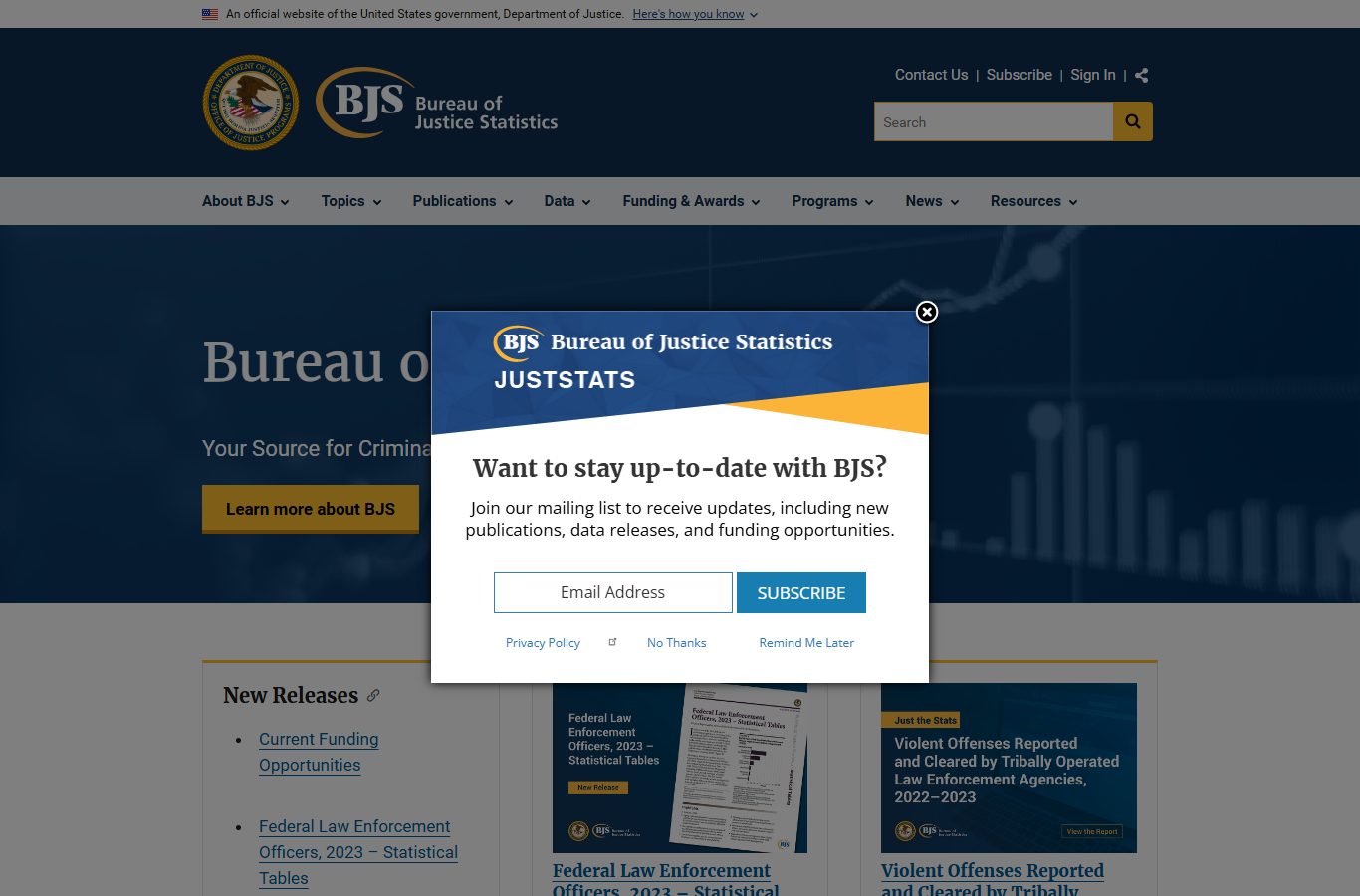
The Bureau of Justice Statistics at bjs.ojp.gov is the official federal statistical agency for criminal justice data; its Jail Inmates series provides the most authoritative national and state comparison figures available for contextualizing the St. Johns County detention population.
St. Johns County Jail Population Trends Over Time
St. Johns County is one of the fastest-growing counties in Florida. The U.S. Census estimates the county population rose from 273,425 at the 2020 Census to 346,328 by July 2025, a 26.7% increase. Population growth of that scale typically increases the pool of people subject to arrest, which can drive jail bookings higher even if the per-capita arrest rate holds steady. Whether the St. Johns County jail population has grown at a rate similar to, faster than, or slower than the general population growth is a question the SJSO annual reports would answer.
Five-year local jail population trend data was not accessible in the SJSO web pages reviewed for this research. Official county-level trend data for Florida jails, including St. Johns, is available through BJS survey filings and the Vera Institute's Incarceration Trends tool, which charts ADP over multi-year periods using BJS-sourced data. Those tools clearly label the data as research-institute products based on agency-reported figures. For the most current local trend data, the SJSO annual report PDFs at sjso.org/annual_reports are the authoritative source. Reports for 2019 through 2023 were available on the site at the time of research. A public records request to the SJSO at (904) 824-8304 can obtain more recent data if the latest annual report has not yet been posted online.
National trends also affect interpretation. U.S. jail populations fell sharply in 2020 due to COVID-19-related declines in arrests and deliberate depopulation efforts by many county jails. By 2022 and 2023, most counties saw populations rebound, though not always to 2019 levels. Florida counties generally followed this pattern. How St. Johns County tracked against that national trend is something the SJSO annual reports would clarify for local researchers and policymakers.
Searching for St. Johns County Inmate Records by Name
The population data on this page covers the detention center as a whole, not individual inmates. For a name-based search of a specific person currently in custody at the St. Johns County jail, use the St. Johns County inmate records page, which explains how to use the SJSO inmate search, what the search results may show, and how to call booking at (904) 209-3125 if an online search is inconclusive.
Where the St. Johns County Jail Population Data Comes From
Three layers of data sources apply to St. Johns County jail population questions. The first is the SJSO itself. The Sheriff's Office is the primary record-keeper for detention data. Annual reports at sjso.org/annual_reports are the authoritative official source. Those PDFs may include booking counts, ADP, staffing, accreditation status, and program data for each reporting year.
The second layer is the Bureau of Justice Statistics. BJS at bjs.ojp.gov collects jail data from counties across the country through the Annual Survey of Jails and the Census of Jails. Florida counties participate in these surveys. BJS publishes aggregate national and state figures and, in census years, county-level detail. These are federal research products based on self-reported agency data; they typically lag by one to two years. The BJS Jail Inmates at Midyear and Census of Jails reports are the most relevant series for St. Johns County context.
The third layer is research institutes that analyze and repackage BJS data. The Vera Institute's Incarceration Trends tool at incarcerationtrends.vera.org makes county-level BJS data accessible through charts and comparisons. The Prison Policy Initiative's Florida profile at prisonpolicy.org/profiles/FL.html provides state-level context combining jail and prison populations. Both sources cite BJS as their data origin and are labeled throughout as research-institute analysis rather than official government statistics.