
St. Johns County Criminal Division Scope
The St. Johns County Clerk's criminal division handles records for four case categories: felonies, misdemeanors, criminal traffic, and county and municipal ordinance violations. The division processes charging documents, records pleas and orders, maintains financial entries for fines and costs, and provides copy and certification services. The same office holds the archival criminal record going back to 1821, though records before roughly the 1990s are not available for online review and must be accessed at public terminals or by public-records request.
Felony cases are circuit court records because the circuit court is Florida's primary trial court for serious crimes. Misdemeanors and most criminal traffic offenses are county court records; the county court handles these as the limited-jurisdiction trial court in St. Johns County. Both sets of records are maintained by the same Clerk's office because Florida has a unified clerk structure: the Clerk of the Circuit Court and County Comptroller is the custodian for both circuit and county court cases.
The image below is from the Clerk's criminal division page, which lists the case categories handled, research options, E-Certify access, and copy request procedures for St. Johns County criminal matters.
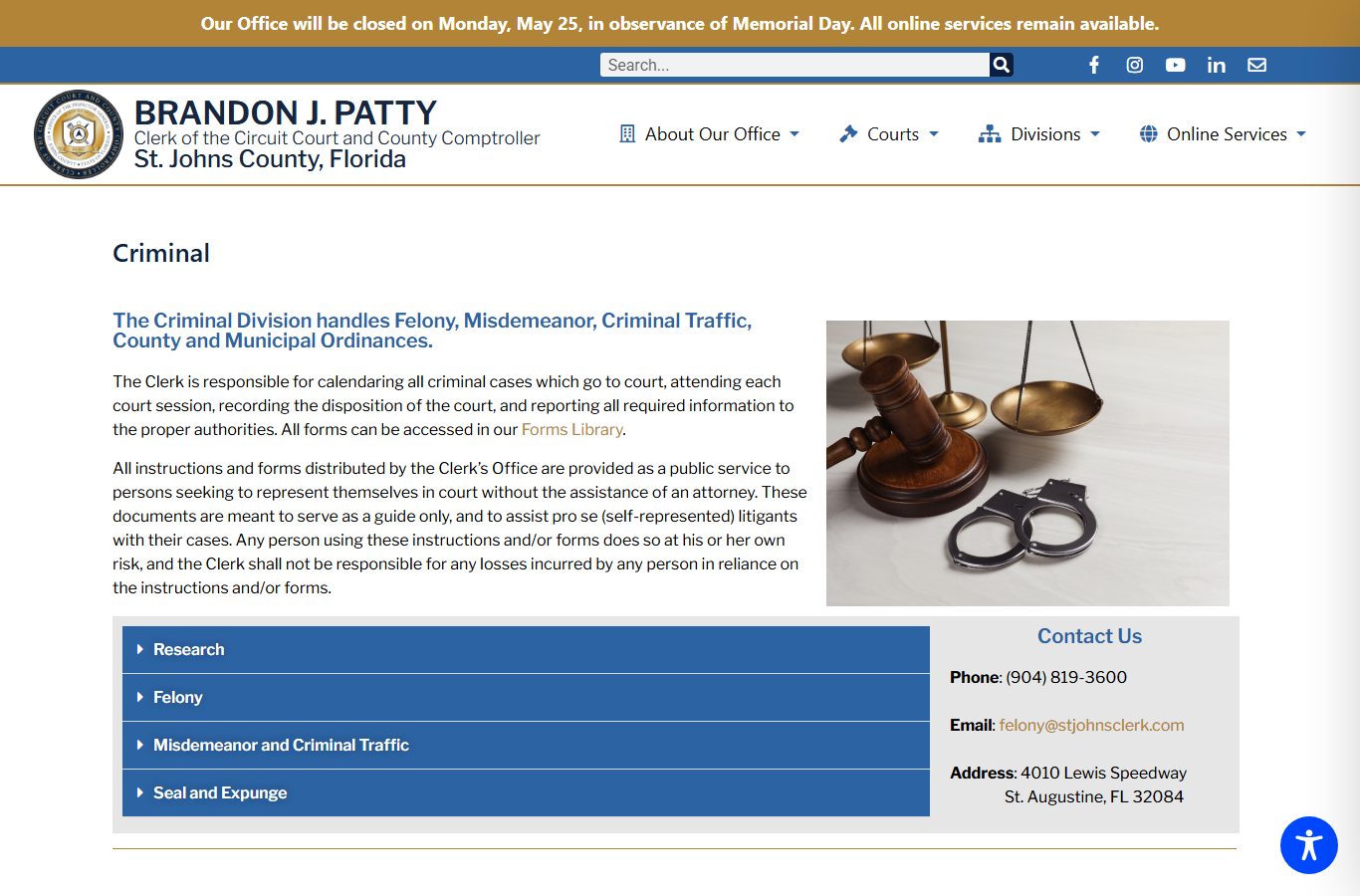
The criminal division page describes the document viewing and copy options available for publicly accessible criminal case records, including free online document viewing and certified copies through E-Certify.
Clerk Criminal Division
4010 Lewis Speedway
St. Augustine, FL 32084
Felony: (904) 819-3618
Misdemeanor: (904) 819-3619
Mon–Fri 8:00 AM–5:00 PM
Charges vs Convictions in St. Johns County Criminal Records
One of the most important distinctions in any criminal record search is the difference between being charged and being convicted. Florida law makes arrest and charging information broadly public, but a charge is not a finding of guilt. Courts can dismiss charges, juries can acquit defendants, and prosecutors can decline to proceed. All of those outcomes appear as dispositions in the Benchmark docket, but the case record stays visible to the public unless it is sealed or expunged.
The comparison table below clarifies the key differences between a charge shown in a St. Johns County criminal record and an actual conviction.
| Category | Charge / Arrest Record | Conviction Record |
|---|---|---|
| What it means | A law enforcement agency or grand jury alleges a person committed a crime. No guilt has been determined. | A court adjudicated the person guilty by verdict, plea, or adjudication of guilt. |
| Who creates it | Law enforcement upon arrest; State Attorney upon filing charging document. | The court upon entry of a judgment of conviction or accepted guilty plea. |
| Where it appears | Arrest records, booking records at SJSO, and charging documents in Benchmark. | Disposition field in the Benchmark case record; also reported to FDLE criminal history. |
| Effect on public record | Public unless sealed, expunged, or automatically sealed after dismissal under s. 943.0595. | Public unless sealed under s. 943.059 or expunged under s. 943.0585; eligibility is very limited after conviction. |
| Can it be restricted? | Possibly. Dismissed cases may be automatically sealed. Charges without adjudication of guilt may qualify for sealing. | Rarely. A withheld adjudication is not technically a conviction but still limits sealing options. Most convictions do not qualify for sealing or expunction. |
Note: Florida law distinguishes between adjudication of guilt (conviction) and a withhold of adjudication. A withheld adjudication is not a conviction under Florida law, but it still appears in the criminal record and affects seal and expunge eligibility in the same way a conviction does for some purposes.
How to Search St. Johns County Criminal Records
Criminal records are searched through the Benchmark portal at the Clerk's online research hub. Choose Court Records to enter Benchmark. To narrow results to criminal matters, use the Court Types filter and select Criminal Felony for circuit-level cases or Misdemeanor and Criminal Traffic for county court cases. A case number search gives the fastest and most precise result. Name searches should include spelling variations and use the Include Alias option for alternate names.
- Go to the Clerk's online research page and open Benchmark.
- Enter the case number if known. Felony and misdemeanor case numbers have different prefixes reflecting court level and year.
- If searching by name, type the last name and try alternate spellings. Enable Include Alias for cases filed under a different name.
- Set Court Types to Criminal Felony, Misdemeanor, Criminal Traffic, County Ordinance, or Municipal Ordinance based on the case category.
- Narrow by Date Opened range if the person has a common name or you need cases from a specific period.
- Click Search and select the matching case from the result list.
- Review the docket entries for charges, pleas, hearing dates, and dispositions.
- For a certified copy of a charging document or court order, use the Get Certified Documents link to E-Certify or contact the criminal division directly at the felony or misdemeanor number above.
For archival criminal cases from 1821 to roughly the 1990s, the Clerk says records are not currently available for online review. Digital scans can be accessed on-site at public access terminals or by submitting a public-records request. The Clerk accepts requests by email at PRR@stjohnsclerk.com, by phone at (904) 819-3600, in person, or through the new public records request portal launched in January 2025.
Mugshots and Booking Photos
Booking photographs are taken by the St. Johns County Sheriff's Office as part of the arrest and booking process. SJSO says upon entry into the facility, the person is entered into the computer system, fingerprinted, and photographed. Those photographs are associated with SJSO booking records, not with Benchmark court case records.
The Clerk's Benchmark portal does not display booking photographs. Mugshots may appear in law enforcement records and, in some cases, in third-party aggregator websites that collect and republish them. Florida law does not guarantee unlimited mugshot publication rights, and some agencies have policies restricting how booking photos are distributed. For official information about a specific arrest, use the SJSO inmate search or contact booking at (904) 209-3125 rather than relying on unofficial mugshot sites.
Unofficial mugshot sites frequently charge removal fees and may not update records to reflect acquittals, dismissed charges, or expunctions. The official Benchmark portal accurately reflects case dispositions and is the better source for verifying the current status of a St. Johns County criminal case.
Warrants and St. Johns County Criminal Records
Active warrants and their supporting affidavits are not shown in public Benchmark search results. Florida Rule of General Practice and Judicial Administration 2.420(c)(6) makes warrants and supporting affidavits confidential until they are served or until law enforcement determines the warrant cannot be executed. This means you will not see a warrant entry in an active case's public docket until after it has been returned as served.
Once a return of service is filed in the case, the warrant and supporting documents become publicly disclosable inside that individual court case. At that point, you can find them by searching the case in Benchmark. A capias entry on a docket, Florida's common term for a court-issued arrest order, often signals a warrant was issued within the case, but the supporting affidavit may stay restricted until served. For active warrant questions, contact the SJSO Court Services/Judicial Process office at (904) 209-1440. For more detail on warrant types and how to resolve an outstanding warrant, see the St. Johns County warrant records page.
Dismissed Cases and Automatic Sealing
A dismissed criminal case does not always vanish from public search results right away, but Florida law has a mechanism that can eventually remove it from anonymous online access. Under Florida Statutes section 943.0595 and Florida Supreme Court Order SC2023-1320, certain all-count dismissed criminal cases can be automatically sealed after FDLE marks the associated criminal history record confidential and exempt and then files notice with the Clerk.
The Clerk's public-records FAQ explains the sequence clearly. First, FDLE must mark the criminal history record confidential as a qualifying dismissal. Then FDLE files notice with the St. Johns County Clerk. Once the Clerk receives that notice, the associated court case is marked confidential and exempt and is no longer viewable online anonymously. Until that notice arrives, a dismissed case may still appear in public Benchmark searches.
The image below is from Florida Statutes section 943.0595 on the Florida Senate website, which sets out the automatic sealing process for qualifying dismissed criminal history records.
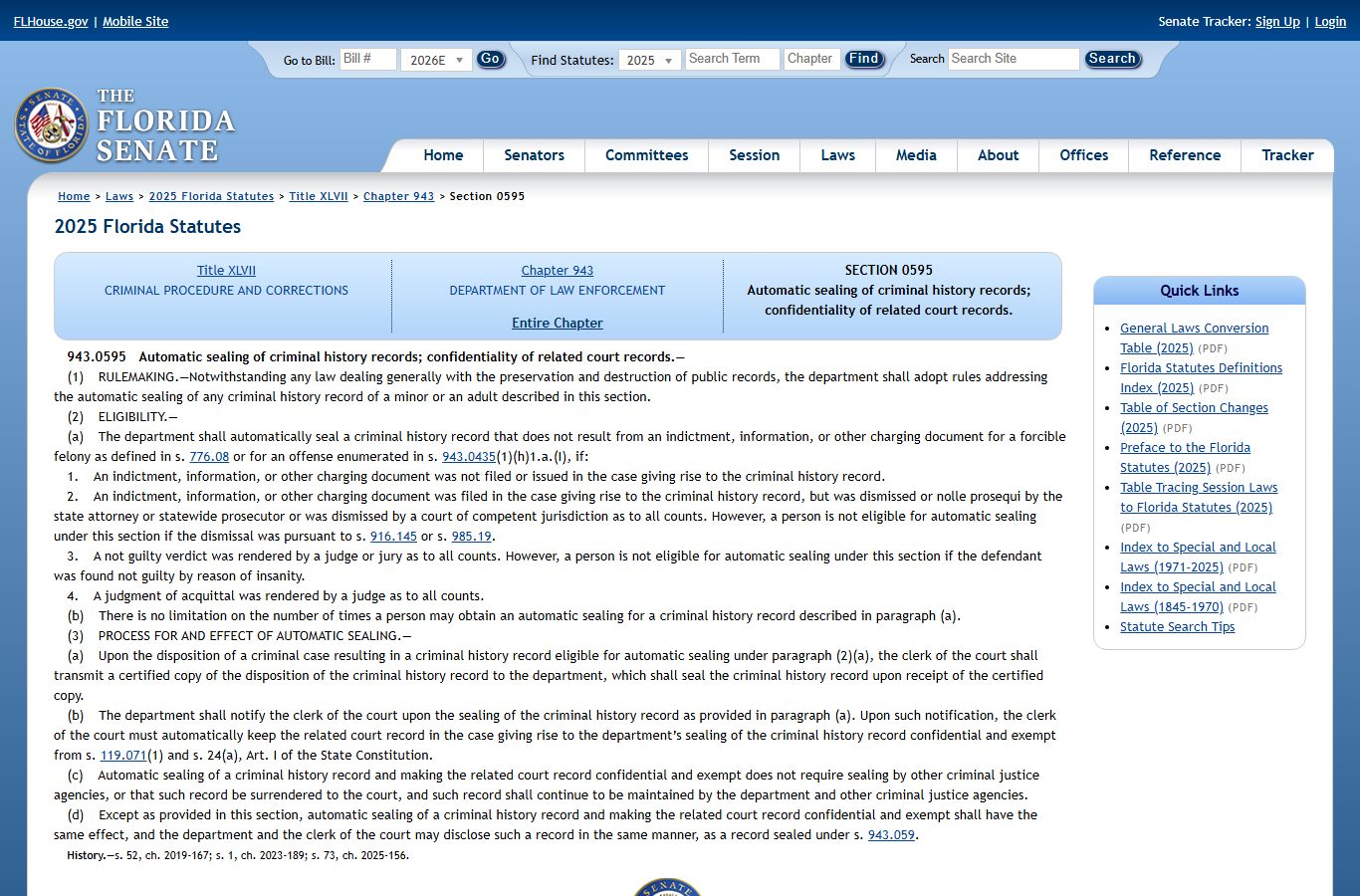
Section 943.0595 establishes the automatic sealing mechanism that the St. Johns Clerk FAQ references. The statute requires FDLE to mark qualifying dismissed records confidential before the Clerk can act on the court file.
Sealing vs Expunging a St. Johns County Criminal Record
Two separate legal processes can restrict access to qualifying St. Johns County criminal records: sealing under Florida Statutes section 943.059 and expunction under section 943.0585. Both require action through FDLE and the court, but they produce different results and have different eligibility requirements.
Sealing restricts public access to the record. Sealed records remain available to certain government agencies and specified employers in sensitive roles, but the general public cannot view them through Benchmark or any public search. Expunction goes further: the record is removed from ordinary public access with even stricter handling rules. A person whose record is expunged can generally deny the arrest in most circumstances, subject to specific exceptions stated in Florida law.
| Category | Sealed Record (s. 943.059) | Expunged Record (s. 943.0585) |
|---|---|---|
| Public access | Restricted from public; not shown in anonymous Benchmark searches. | Removed from public access; record treated as though it does not exist in most contexts. |
| Law enforcement access | Accessible to specified agencies in defined circumstances. | Accessible to specified agencies in defined circumstances; stricter handling than sealing. |
| Can deny the arrest? | Limited ability to deny; depends on the situation and query type. | Generally may deny the arrest except in specifically listed circumstances such as certain licensing or employment applications. |
| Eligibility | Generally requires no prior adjudication of guilt, no prior sealing or expunction, and a qualifying offense. FDLE certificate of eligibility required in most cases. | Stricter criteria. Generally requires no prior adjudication and no prior sealing or expunction. Some offense types are permanently ineligible. |
| Clerk filing fee | $54.00 | $54.00 |
| FDLE step | FDLE Certificate of Eligibility required in most cases before filing the court petition. | FDLE Certificate of Eligibility required in most cases before filing the court petition. |
The FDLE seal and expunge process page, shown below, describes the steps involved in applying for a certificate of eligibility and then petitioning the court in the county where the case was handled.
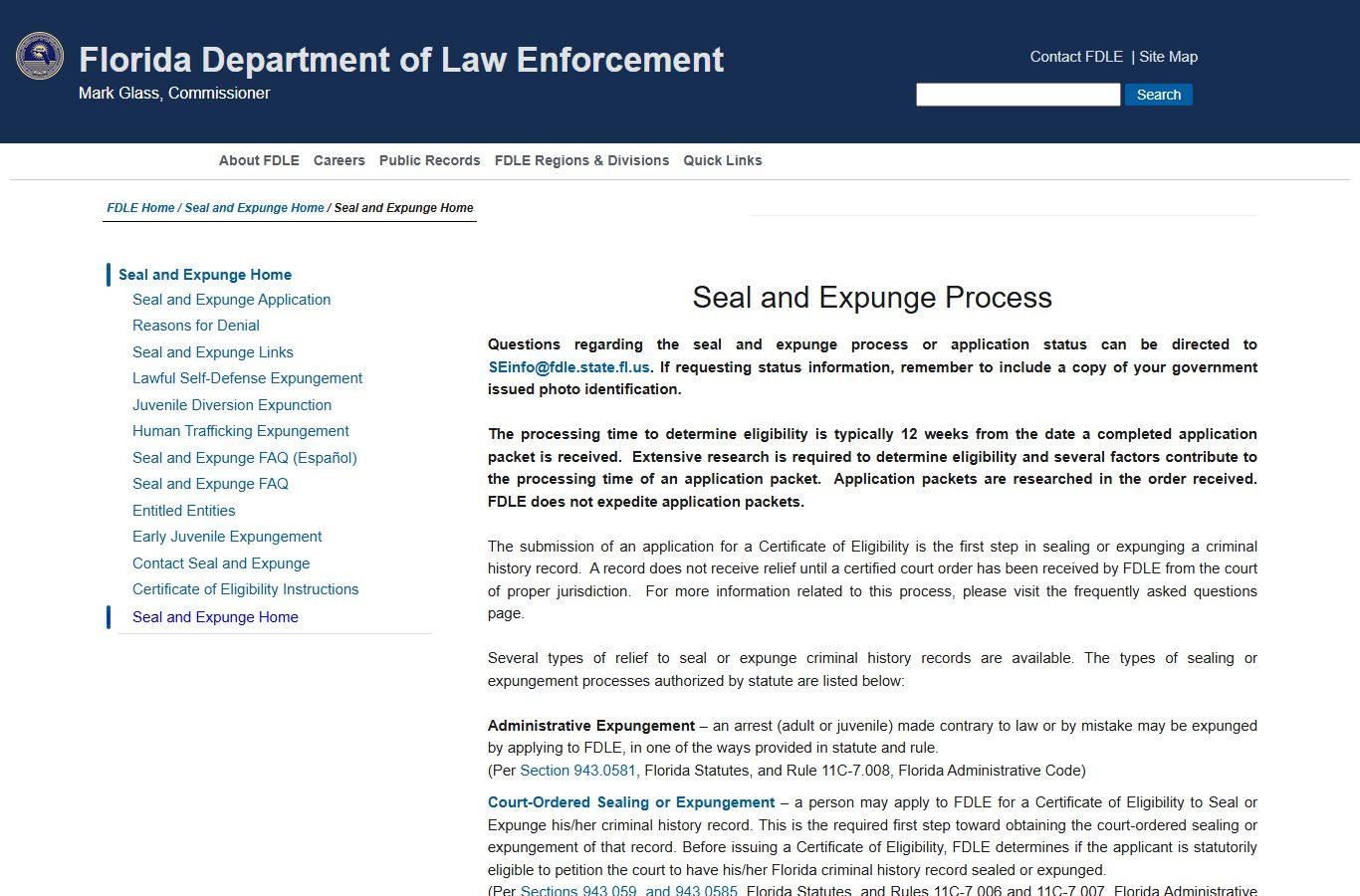
The FDLE Seal and Expunge home page is the official starting point for Floridians seeking to restrict access to qualifying criminal history records. FDLE eligibility review comes before the St. Johns court petition can be filed.
Starting the Seal or Expunge Process
The St. Johns Clerk fee schedule lists a $54 filing fee for sealing any court file or expungement of any record. Before filing in court, most applicants must obtain a Certificate of Eligibility from FDLE. The Clerk's seal and expunge packet is in the Forms Library and can be used alongside the FDLE eligibility application.
- Review your criminal history with FDLE and determine whether the offense and case type qualify under section 943.059 or 943.0585.
- Apply to FDLE for a Certificate of Eligibility. FDLE checks prior adjudications, prior sealings or expunctions, and other eligibility factors.
- If FDLE issues the certificate, file a petition in the St. Johns County circuit court that handled the case.
- Pay the $54.00 Clerk filing fee at the time of filing.
- Serve the petition on required parties, including the State Attorney's office. State Attorney R.J. Larizza leads the Seventh Judicial Circuit office and may review and object to the petition.
- A judge reviews the petition and, if granted, issues a sealing or expunction order directing the Clerk and other agencies to act on the record.
- Confirm with the Clerk that the record has been updated per the court order before assuming the restriction is in effect.
State Attorney and Public Defender in St. Johns County
Criminal cases in St. Johns County are prosecuted by the Seventh Judicial Circuit State Attorney's Office, headed by State Attorney R.J. Larizza. Florida uses the title State Attorney rather than District Attorney. SAO7 covers Flagler, Putnam, St. Johns, and Volusia counties and maintains a St. Augustine office. The State Attorney's office reviews arrest reports, files charging documents, negotiates pleas, and represents the State at hearings and trials in both circuit and county court.
Eligible defendants who cannot afford an attorney are represented by the Seventh Judicial Circuit Public Defender's Office, led by Public Defender Matthew Metz. PD7 serves the same four-county circuit and handles both felony and county court criminal defense. Applications for public defender services are available at the PD7 website, including a specific St. Johns County application form. Eligibility depends on the case type, indigency, and judicial appointment.
For defendants who do not qualify for a public defender, the Florida Bar Lawyer Referral Service can connect individuals with a private defense attorney. The referral service offers a 30-minute consultation for no more than $25. Call 1-800-342-8011 Monday through Friday, 8:00 AM to 5:30 PM, or submit an online request. Jacksonville Area Legal Aid handles civil legal matters but can assist with related issues such as housing or employment following a criminal case.
Arrest, Booking, and the Criminal Court Record
An arrest in St. Johns County typically results in booking at the St. Johns County Detention Center, operated by the Sheriff's Office at 3955 Lewis Speedway, St. Augustine. SJSO booking creates an arrest record in the Sheriff's system. That is a law enforcement record, kept separate from the court record the Clerk maintains in Benchmark.
The court record begins when a charging document is filed with the Clerk, usually an information filed by the State Attorney or an indictment returned by a grand jury. From that point forward, every case event goes through the Clerk and appears in Benchmark as a docket entry. The booking record and the court case record can both reference the same arrest, but they are held by different offices and searched through different systems. The SJSO inmate search shows custody status; Benchmark shows the court case status. For more on the booking and jail process, see the St. Johns County inmate records page.
For DUI and other serious traffic offenses treated as criminal traffic, the court record appears in Benchmark under Criminal Traffic. Those cases often have significant overlap with license consequences tracked by the Florida Department of Highway Safety and Motor Vehicles. For that connection, the traffic court records page explains the distinction between the court record and the state driver record.
Confidential and Restricted Criminal Records
Several categories of criminal records are restricted from anonymous public access in St. Johns County. Knowing these categories helps explain why some cases may not appear in a Benchmark search even though an arrest occurred.
- Juvenile records are confidential under Florida Statutes section 985.04. Juvenile delinquency and dependency cases are not treated as ordinary public records.
- Sealed records are restricted after a court-ordered sealing under section 943.059. The record exists but is not visible in public anonymous searches.
- Expunged records are removed from ordinary public access after a court-ordered expunction under section 943.0585.
- Automatically sealed dismissed cases become confidential after FDLE notice under section 943.0595 and Supreme Court Order SC2023-1320.
- Active warrants and supporting affidavits are confidential under Rule 2.420(c)(6) until served.
- Victim information in sexual offense, domestic violence, and child abuse cases is protected under chapter 119 exemptions.
- Personal identifying information such as social security numbers and financial account numbers is redacted from public docket data under chapter 119 and Rule 2.420.
For a full treatment of restricted records across all case types, the St. Johns County court records page covers the public access framework under chapter 119, Florida Statutes, and Rule 2.420.