
Common Questions About St. Johns County Court Records
How do I search St. Johns County court records online?
Use the official Clerk online research hub and choose Court Records to open the Benchmark portal. You can search by name, case number, citation number, date opened, date closed, court type, cause of action, party type, and statutes or charges. A case number gives the fastest and narrowest result. If you only have a name, try spelling variations and apply a date range to cut down a long list. The search is free and updates in real time. For recorded official records such as deeds and marriage licenses, use the separate Landmark Official Records portal. See the court records page for a full walk-through and search-field table.
Are St. Johns County court records updated in real time?
The Clerk says court searches are real time, meaning the Benchmark portal reflects records as they exist in the Clerk's system at the moment you search. That does not mean every document in every case is publicly viewable. Sealed, confidential, expunged, juvenile, active-warrant, and restricted documents may be withheld or redacted even when the underlying case appears in search results. If a filing that you expected is missing from a public result, call the relevant Clerk division or submit a public records request. See public records for request channels.
How far back do St. Johns County court records go?
The Clerk divides records into Modern Era Records, covering roughly the 1990s to the present, and Archival Records, covering 1821 to roughly the 1990s. St. Johns County is one of Florida's oldest counties, established in 1821. Most publicly disclosable modern records are available online through Benchmark. Archival criminal and civil records are not available for remote online review at this time, though digital scans can be viewed on-site at public access terminals at the courthouse or obtained through a public records request. Contact the Clerk at (904) 819-3600 for archival record inquiries.
Does the Clerk show dismissed criminal cases online?
Sometimes, but not always. Under Florida Statutes § 943.0595 and Florida Supreme Court Order SC2023-1320, certain criminal cases dismissed as to all counts can become confidential after FDLE marks the associated criminal history record confidential and files notice with the Clerk. Until the Clerk receives that notice, a dismissed case may be visible to anonymous users online. After the Clerk receives the notice, the case is marked confidential and removed from anonymous online viewing. For more detail on how dismissed cases work, see the criminal records page.
Does the Clerk publish active warrants?
No. The Clerk says it does not publish active warrant information. Under Florida Rule of General Practice and Judicial Administration 2.420(c)(6), warrants and supporting affidavits are confidential and exempt from public disclosure until they are served or until law enforcement determines the warrant cannot be executed. After a return of service is filed in the individual case, the warrant documents may become publicly disclosable inside that case record, but the Clerk does not publish a separate active warrant list. For warrant contact information and how to resolve an outstanding warrant, see the warrant records page.
Who do I call about a St. Johns County warrant?
Contact the St. Johns County Sheriff's Office Court Services and Judicial Process division at the warrants phone number (904) 209-1440. That office is at 3955 Lewis Speedway, St. Augustine, FL 32084, and is open Monday through Friday, 8:00 AM to 5:00 PM. If the warrant may involve a criminal case, it is strongly advisable to speak with a defense attorney before appearing or making statements to law enforcement. See the warrant records page for the step-by-step resolution process.
How do I find an inmate in the St. Johns County jail?
Start with the official SJSO inmate search linked from the Sheriff's website at sjso.org and the jail FAQ page. If the online search does not show what you need, contact booking at (904) 209-3125 or SJSO non-emergency at (904) 824-8304. The St. Johns County Detention Center is at 3955 Lewis Speedway, St. Augustine, FL 32084. It operates the Main Detention Unit for pre-trial and sentenced inmates and the Community Work Re-Entry Center for sentenced inmates. For full inmate search guidance, see the inmate records page.
How do I send mail to an inmate at the St. Johns County jail?
All non-legal inmate mail must go to Smart Communications/St. Johns County Jail, Inmate Name and Inmate ID Number, PO Box 9102, Seminole, FL 33775-9151. Regular mail is scanned into tablets and kiosks inside the facility; original mail is destroyed after 30 days. Do not send original birth certificates, marriage licenses, Social Security cards, or other irreplaceable documents. Legal mail must be marked "Legal Mail" and is opened in the presence of an Inmate Communications Specialist. For the full mail and visitation rules, see the inmate records page.
How do I search for sex offenders in St. Johns County?
The official source is the FDLE Sexual Offender and Predator Search at offender.fdle.state.fl.us. The SJSO also links to this registry and to OffenderWatch for a community-focused view. You can search by name or by address and county to find registered offenders near a location. FDLE reminds users that positive identification cannot be established without fingerprint comparison and that the registry should not be used to harass or threaten registered persons.
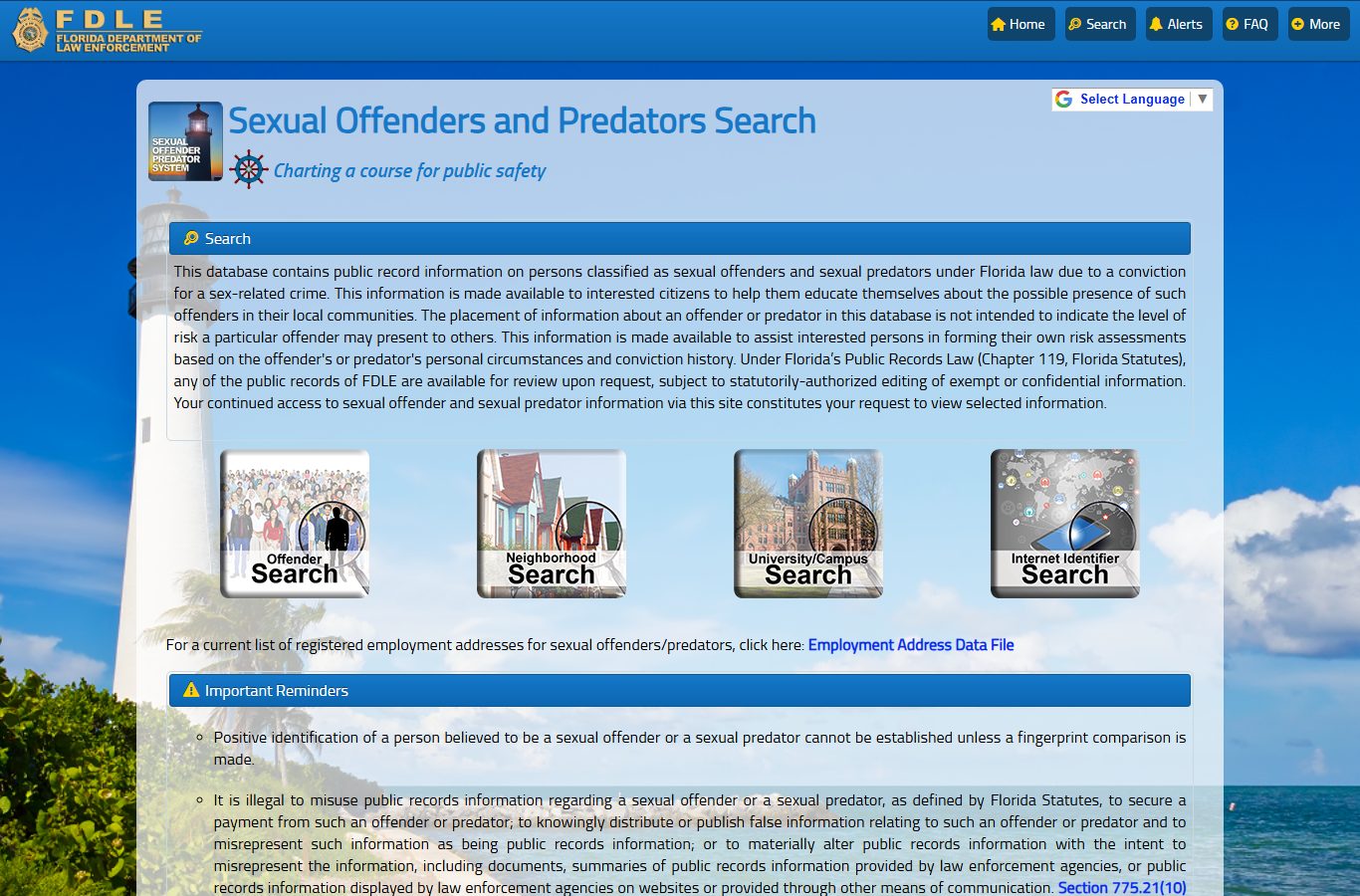
The FDLE Sexual Offender and Predator Search covers registered offenders statewide, including those in St. Johns County, and allows searches by name, county, or address.
Where are probate records found in St. Johns County?
Probate records are searched in Benchmark under Court Types such as Probate, Deceased Without Administration, Guardianship, Incapacity, Trust Administration, and Wills On Deposit. Probate is a function of the circuit court; there is no separate elected probate court in St. Johns County. The Clerk maintains all probate files. Some guardianship and incapacity records may be restricted under Florida law. For filing fees, contact information, and the step-by-step search process, see the probate records page.
How much does a marriage license cost in St. Johns County?
Florida residents who both complete a qualifying premarital education course of at least four hours pay $61 and face no waiting period. Florida residents who skip the course pay $86 and must wait three days before the license is active. If one or both parties are out-of-state residents, the fee is $86 and there is no waiting period. Clerk ceremonies cost $30. Photo services at the main courthouse cost $15. Additional certified copies of a recorded license are $3 each. See the marriage and divorce records page for the full fee table and office locations.
How do I search divorce records in St. Johns County?
Florida calls divorce "dissolution of marriage." Dissolution cases are circuit court records searchable in Benchmark under Court Types Domestic Relations/Family and dissolution-related cause types. You can search by name, case number, or date range. Divorce records are court files, not vital-record certificates. Some financial documents and minor-related information may be restricted. For certified copies of final judgments, contact the Clerk's court records office or use E-Certify online. See the marriage and divorce records page for the full divorce search workflow.
How do I pay or contest a traffic ticket in St. Johns County?
Payments are due within 30 days of receiving the citation. Options include paying online through the Clerk's traffic payment link, submitting proof of compliance by email to traffic@stjohnsclerk.com, electing traffic school which adds 60 days to complete, or requesting a court appearance if you want to contest the ticket. Unpaid fines go to a collection agency after 90 days, which can add up to 40% to the amount owed. The Clerk will never call or text you demanding payment; if you get such a contact, report it to the Clerk at (904) 819-3600. See traffic court records for the full options and step-by-step process.
How do I find federal court records involving St. Johns County?
St. Johns County is in the Jacksonville Division of the U.S. District Court for the Middle District of Florida. Federal case records are accessed through PACER at pacer.uscourts.gov, which requires an account registration. The CM/ECF system at ecf.flmd.uscourts.gov is the official filing system for the Middle District. The Jacksonville Division federal courthouse is the Bryan Simpson United States Courthouse in Jacksonville, not in St. Augustine. For some opinions and RECAP-uploaded documents, CourtListener at courtlistener.com offers free access without PACER fees.
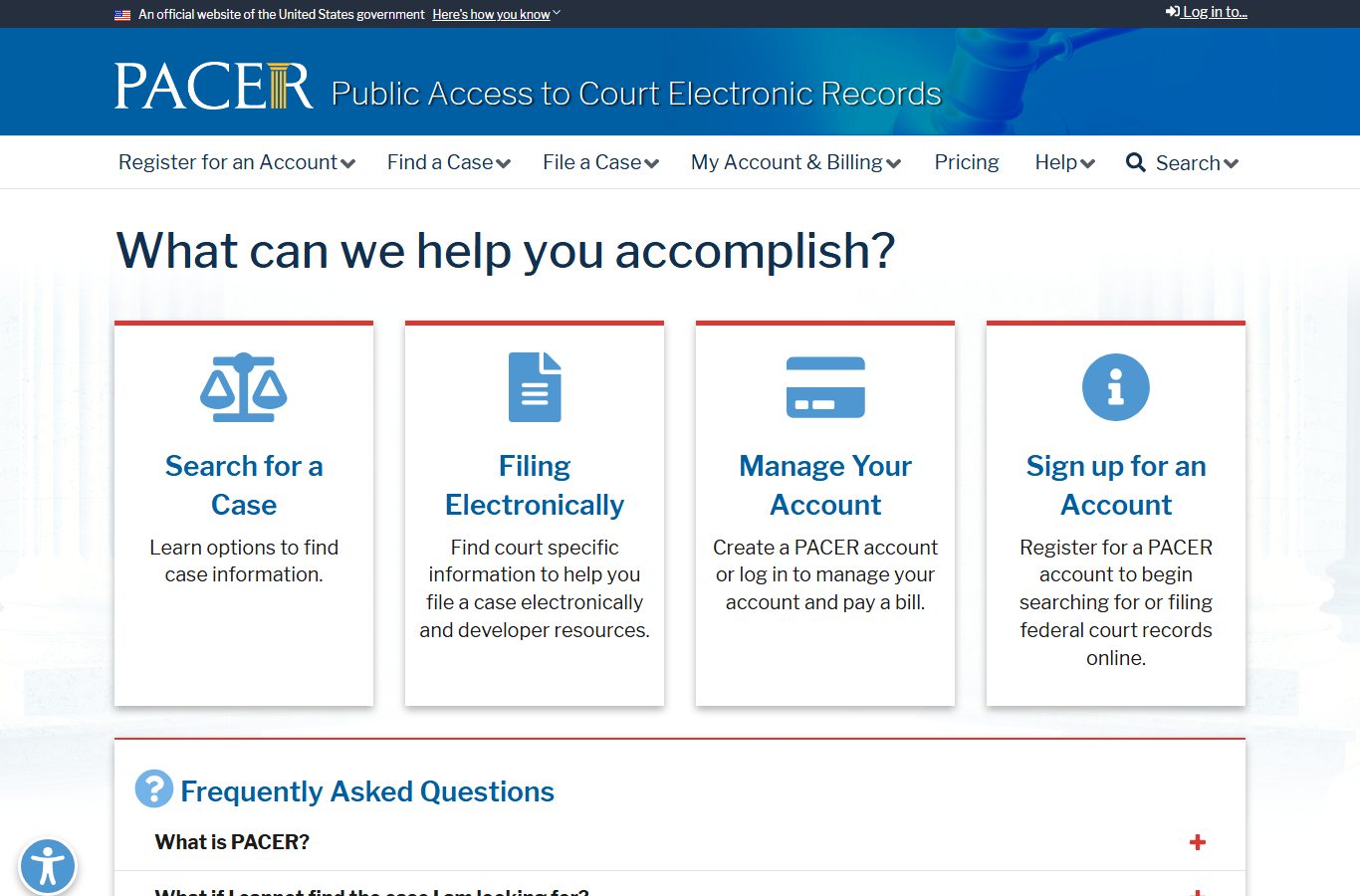
PACER is the official portal for federal court records in St. Johns County cases filed in the Jacksonville Division of the U.S. District Court for the Middle District of Florida.
How do I get legal help if I cannot afford an attorney?
For civil legal aid, contact the Jacksonville Area Legal Aid St. Johns County office at 222 San Marco Avenue, St. Augustine, FL 32084, phone (904) 827-9921. JALA handles general civil cases for low-income, elderly, and disabled residents. For criminal defense, apply through the Seventh Judicial Circuit Public Defender at pd7.org if you are eligible for appointed counsel. The Florida Bar Lawyer Referral Service at 1-800-342-8011 matches clients with licensed attorneys and offers an initial 30-minute consultation for no more than $25. See the Clerk of the Circuit Court page for more local resource links.
What does the Prison Policy Initiative report show about Florida incarceration?
The Prison Policy Initiative Florida profile provides statewide incarceration context including the number of people incarcerated in state prisons, local jails, federal facilities, and on supervision in Florida. The profile is a research resource, not an official government database. It does not include individual inmate records and cannot be used to search for a specific person. For individual St. Johns County inmate records, use the SJSO inmate search. For state prison records, use the Florida Department of Corrections offender search at dc.state.fl.us.
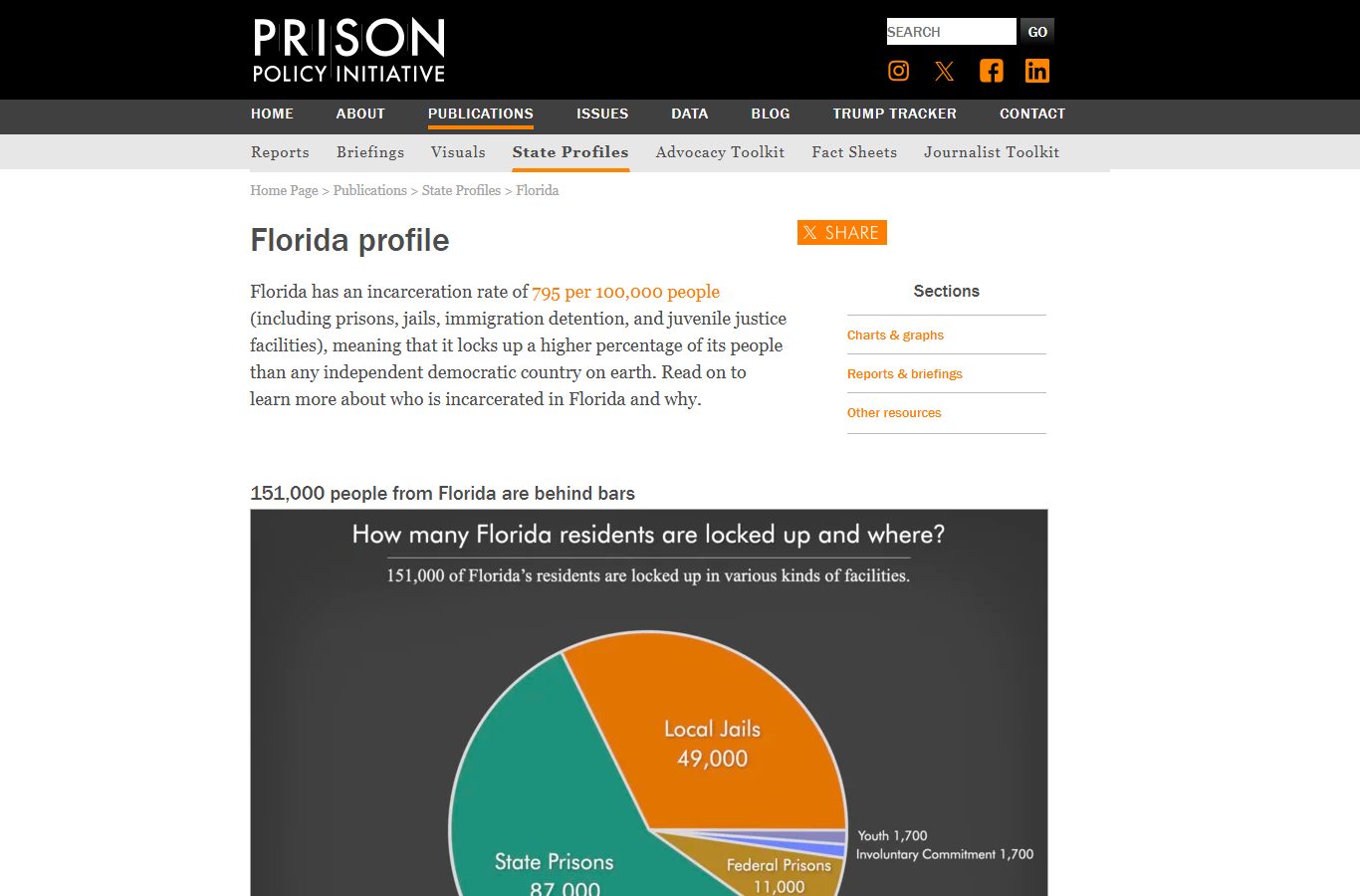
The Prison Policy Initiative Florida profile gives state-level incarceration statistics that put St. Johns County detention data into broader context, though it is not a source for individual inmate searches.
Still Have Questions?
For the right office and contact details, see the Clerk of the Circuit Court. For broader access rules and request procedures, see public records. For records by topic, browse court records, criminal records, inmate records, warrant records, marriage and divorce, probate, or traffic court records. For circuit and county court structure, see the Circuit Court page.