
Getting a Marriage License in St. Johns County
Marriage licenses in St. Johns County are issued by the Clerk of the Circuit Court and County Comptroller. The Clerk operates three office locations where couples can apply. The main courthouse office at 4010 Lewis Speedway in St. Augustine is open Monday through Friday from 8:00 AM to 5:00 PM and does not require an appointment. Both the Julington Creek Annex at 725 Flora Branch Boulevard in St. Johns and the Ponte Vedra Annex at 151 Sawgrass Corners Drive in Ponte Vedra Beach require appointments. The annexes are open Monday through Friday from 9:00 AM to 3:30 PM, though the Ponte Vedra location is only open Monday and Wednesday. You can reach the marriage office by phone at (904) 819-3600 or by email at marriage@stjohnsclerk.com.
Before visiting any location, the Clerk asks both applicants to register on the marriage kiosk system online and complete the required premarital statement form. This step saves time at the counter. Both parties must appear together in person; the license cannot be obtained by just one person alone. A Florida marriage license is valid only in Florida and expires after 60 days from issuance. If the license is not used within that window, you must apply again and pay again.
The Clerk's marriage license page is the official source for current fees and office details. You can see the full list of locations, hours, and requirements at stjohnsclerk.com/marriage-licenses-ceremonies.
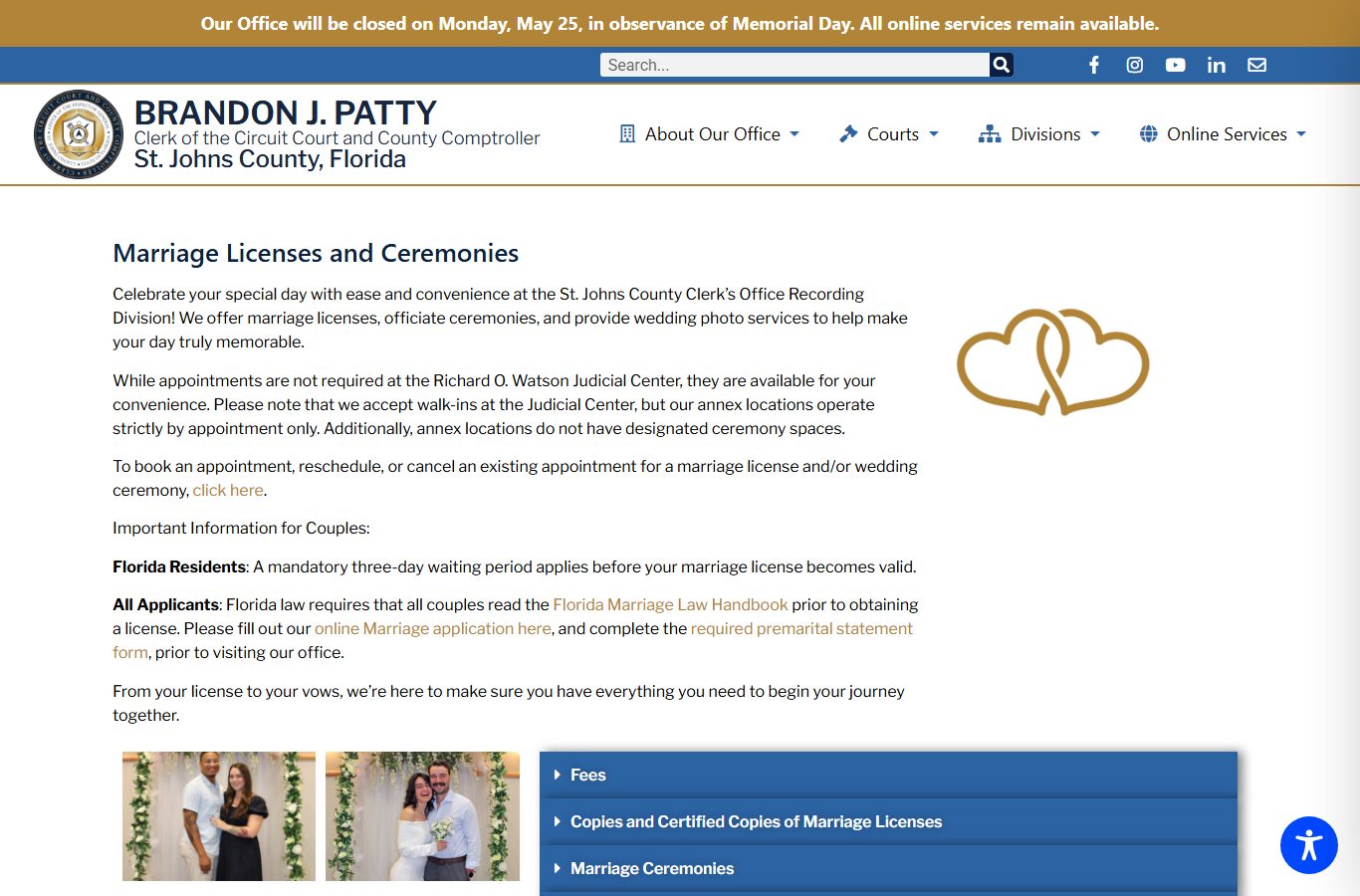
The marriage page lists all three office locations, appointment requirements, fees, and the kiosk registration link that both applicants must complete before their visit.
St. Johns County Marriage License Fees and Waiting Periods
Florida law sets different fees depending on residency and whether both parties completed a qualifying premarital course. Florida residents who both finish a state-approved premarital education course of at least four hours pay a reduced fee and face no waiting period. Residents who skip the course pay a higher fee and must wait three days before the license becomes active. Nonresidents pay the same higher fee but have no waiting period at all. The course must have been completed within the past year, and the certificate must state whether instruction was in person or by another method.
The fee schedule below covers the main marriage-related charges. Additional services such as Clerk-performed ceremonies and photo sessions are also listed.
| Item | Fee / Rule |
|---|---|
| Florida residents, both completed premarital course | $61.00, no waiting period |
| Florida residents, no premarital course | $86.00, 3-day waiting period |
| One or both parties out-of-state residents | $86.00, no waiting period |
| Duplicate license (original unrecorded, lost) | $30.00 |
| Wedding ceremony by Clerk | $30.00 |
| Wedding photo services (courthouse only) | $15.00 |
| Notary service | $10.00 |
| Copy of marriage license, per page | $1.00 |
| Certification of marriage license | $2.00 |
| Additional certified marriage copy | $3.00 |
Blood tests are not required in Florida. There is also no citizenship or residency requirement to apply for a Florida license. A license applied for in St. Johns County can be used anywhere in Florida.
The Clerk's FAQ page answers many common questions about course certificates, officiants, and certified copy timing. See stjohnsclerk.com/faqs for the full list.
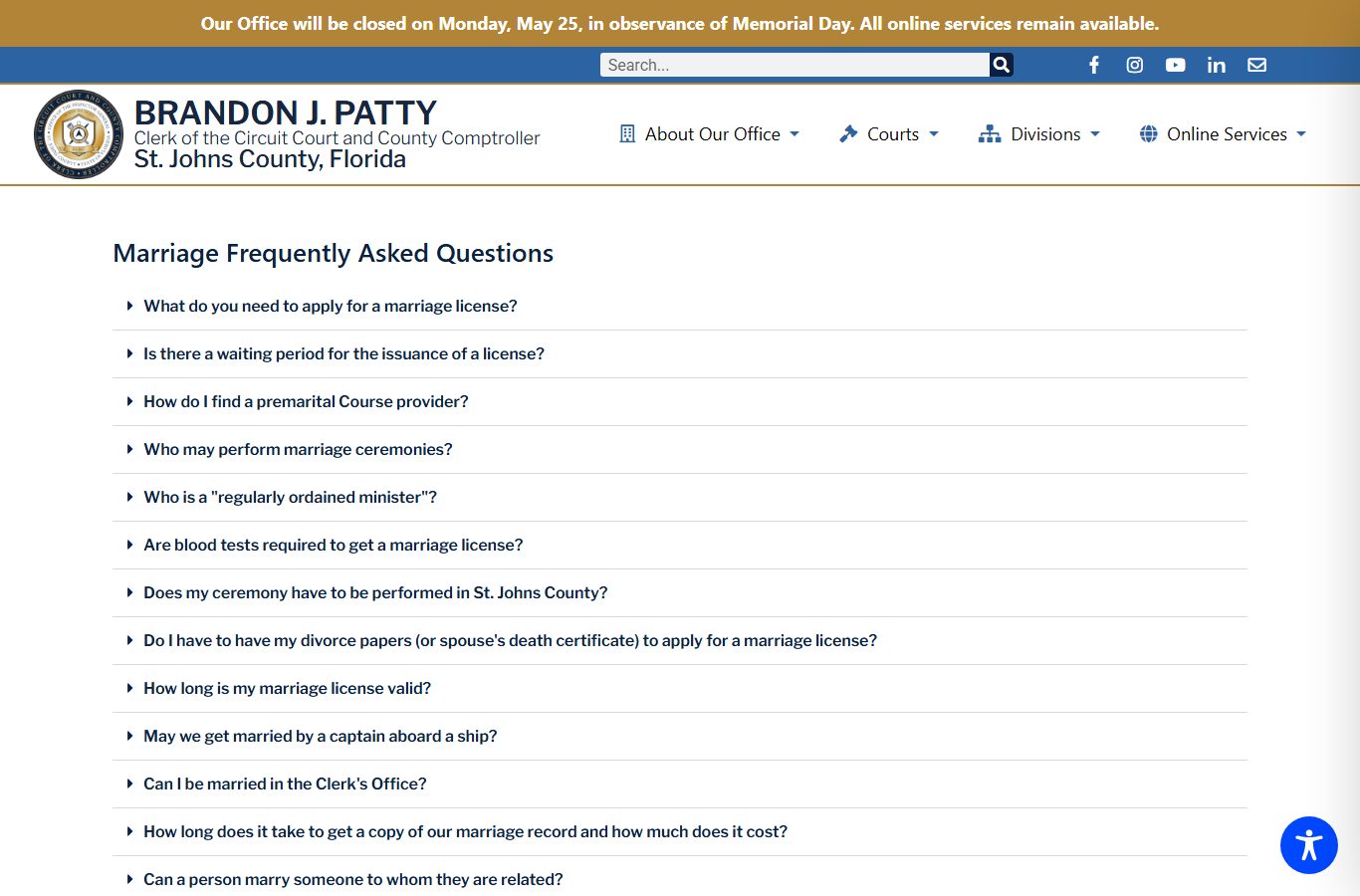
The FAQ page covers the premarital course certificate requirements, what the certificate must say, and how long after the ceremony to expect a certified copy.
Marriage License Application Fields
The Clerk asks both applicants to register on the kiosk system and complete the premarital statement before arriving at any office. The kiosk gathers personal information from each party. When you arrive at the counter, staff confirm the information and collect the required fee. The table below describes what the application process covers based on the Clerk's published requirements and standard Florida marriage license practice.
| Field / Item | Required | Notes / Format |
|---|---|---|
| Full legal name | Yes | Each applicant; include any prior names if applicable. |
| Date of birth | Yes | Both parties must be 18 or older; minors have separate rules. |
| Current address | Yes | Determines Florida vs. nonresident fee and waiting period. |
| Social Security number | Yes (Florida residents) | Required for Florida residents; used for state records only. |
| Prior marriage status | Yes | Number of prior marriages; date and manner each ended (divorce, death, annulment). |
| Photo identification | Yes | Valid government-issued ID for both parties. |
| Premarital course certificate | If claiming course discount | Must show at least 4 hours, within past year, and instruction method. |
| Premarital statement form | Yes | Clerk requires this to be completed before the visit via the online kiosk. |
| Party names for copy requests | Yes (for record copies) | Include maiden name if known; date of marriage helpful but not always required. |
Note: The Clerk does not perform blood tests or require proof of citizenship. If a prior marriage ended in divorce, bring documentation of the final divorce date if you have it, since staff may ask for it to confirm the prior marriage is legally ended.
How to Apply for a Marriage License in St. Johns County
The process takes most couples less than an hour at the counter once they have completed the online registration steps. The waiting period, if one applies, runs from the date of issuance, not the date of the ceremony booking. Plan ahead so the waiting period does not conflict with the ceremony date.
- Go to the Clerk's marriage page at stjohnsclerk.com/marriage-licenses-ceremonies and complete the kiosk registration and premarital statement form before your visit. Both parties must register.
- Gather valid government-issued photo ID for each party, any premarital course certificate if claiming the reduced fee, and documentation of how any prior marriages ended.
- Decide which office to visit. The main courthouse at 4010 Lewis Speedway, St. Augustine, accepts walk-ins Monday through Friday, 8:00 AM to 5:00 PM. The Julington Creek and Ponte Vedra annexes require scheduled appointments.
- Both parties appear together in person at the counter. Staff verify the kiosk information, collect documents, and process the application.
- Pay the applicable fee: $61 if both completed the premarital course, $86 otherwise. Card payments carry a 3.5% convenience fee; cash or check also accepted.
- If a 3-day waiting period applies, the license becomes active after that period. Nonresidents and course-certificate holders have no wait.
- Use the license within 60 days. After the ceremony, the officiant fills out and signs the license and returns it to the Clerk for recording. A certified copy comes back to the couple within about 10 days after the Clerk receives the returned license.
Who Can Perform a Marriage Ceremony in Florida
Florida law allows several categories of people to solemnize a marriage. Regularly ordained ministers, elders, or other clergy of any religion may perform ceremonies. Judicial officers, including retired judges, are authorized. The Clerk of the Circuit Court can also perform ceremonies, which is the source of the $30 Clerk ceremony option in St. Johns County. Florida notaries public have the authority to officiate. Members of the Religious Society of Friends, commonly called Quakers, may solemnize marriages in their own traditional manner. There is no requirement for a specific faith affiliation, and the officiant does not need to be based in St. Johns County or even in Florida.
After the ceremony, the officiant is responsible for completing and signing the marriage license. The signed license is then returned to the Clerk, either dropped off in person or mailed to the Recording Division at 4010 Lewis Speedway, St. Augustine, FL 32084. The Clerk records it in Official Records and sends a certified copy to the couple.
How to Look Up St. Johns County Marriage Records
Recorded St. Johns County marriage licenses are searchable through the Landmark Official Records portal at apps.stjohnsclerk.com/Landmark. This is the same system the Clerk uses for deeds, mortgages, and other recorded instruments. Once the license is recorded, it appears in Official Records and can be searched by party name, document type, or record date. The portal opens with a disclaimer you must accept before searching.
For a written copy request, send both parties' names (including maiden name if applicable) and the date of marriage to the St. Johns County Clerk of the Circuit Court and County Comptroller, Recording Division, 4010 Lewis Speedway, St. Augustine, FL 32084. Include payment for the applicable copy fee. If the license was applied for or recorded in another Florida county, you must contact that county's clerk.
Note: A recorded marriage license in Landmark is an official record, not the same as a court case docket. Do not look for it in the Benchmark court case system.
Finding St. Johns County Divorce Records
Florida calls divorce "dissolution of marriage." Dissolution cases are circuit court family records maintained by the Clerk and searchable through the Benchmark court case portal. To search, go to the Clerk's online research hub, choose Court Records, and select Domestic Relations/Family under Court Types or choose a dissolution cause type from the Causes of Action list. You can search by name, case number, or date range.
A dissolution file may include the petition, any response from the other party, financial affidavits, a parenting plan if children are involved, child support guidelines worksheets, mediation agreements, court orders, and the final judgment. Financial affidavits and documents relating to minor children may be redacted or restricted from full public view. The final judgment itself is generally a public record and is the document most people need for legal name changes, benefits updates, or loan applications. Certified copies of final judgments can be ordered through the Clerk or through the E-Certify system online.
The Clerk's family law page at stjohnsclerk.com/courts/family-law covers divorce-related filings, injunctions, name changes, and related family matters handled by the Clerk's office.
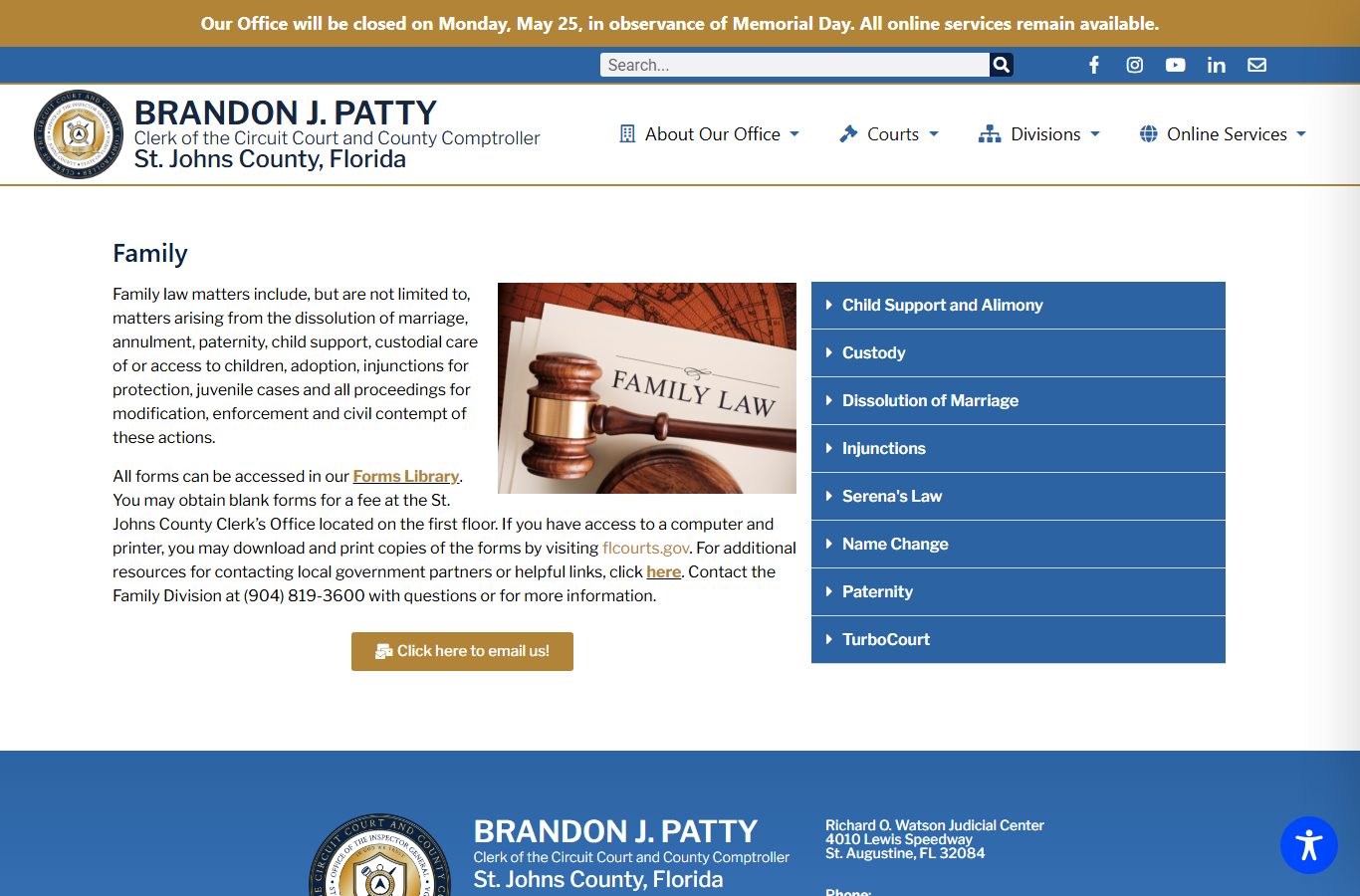
The family law page lists the types of cases the Clerk handles, including dissolution of marriage, paternity, injunctions, name change, and the Serena's Law public injunction database.
Filing for Dissolution of Marriage in St. Johns County
To file a dissolution case, at least one spouse must have lived in Florida for six months immediately before filing. The case is filed with the Clerk in the county where either spouse resides. For St. Johns County residents, the file goes to the Clerk at the Richard O. Watson Judicial Center. Florida Courts provide self-help forms for dissolution at flcourts.gov, and the Clerk's Forms Library also has local family law forms. Self-represented litigants can use these, though the Clerk cannot give legal advice on which form to use or how to fill it out.
- Confirm at least one spouse meets the six-month Florida residency requirement.
- Choose the right Florida family law form: simplified dissolution for couples with no minor children, property disputes, or support issues; standard dissolution for contested or more complex cases.
- File electronically through the Florida Courts E-Filing Portal at myflcourtaccess.com or in person at the Clerk's office. Mail filing may be allowed; confirm with the Clerk before mailing original documents.
- Pay the filing fee or apply for an indigency waiver if eligible. The Clerk fee schedule lists current civil filing fees.
- Serve the other spouse unless both proceed jointly under the simplified process.
- Complete financial disclosure, parenting steps if minor children are involved, mediation if ordered, and any final hearing.
- After the final judgment, request certified copies from the Clerk for name change, Social Security, benefits, or any other purpose that requires official proof.
The Clerk's family law page links to the injunctions page for domestic violence protective orders under Florida Statutes § 741.30, which covers injunctions for protection against domestic violence and applies to cases where a dissolution and a protection order intersect.
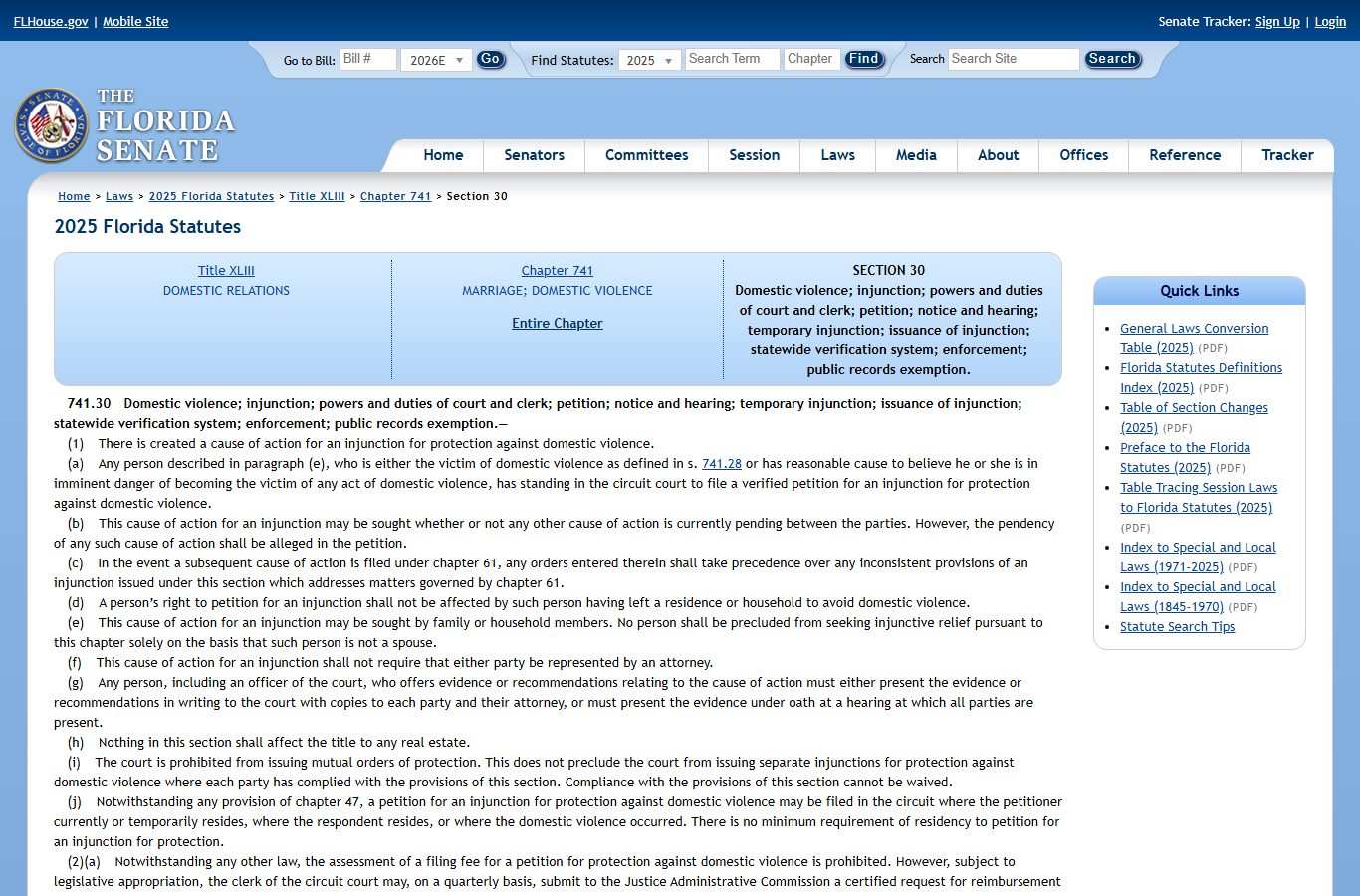
Section 741.30 sets out the standards for domestic violence injunctions in Florida, which the Clerk's family division handles alongside dissolution of marriage cases.
Restricted Information in St. Johns County Family Records
Not every document in a dissolution file is open to the public. Financial affidavits are sensitive because they contain income, asset, and debt information. Under Florida court rules and statutes, documents with Social Security numbers, bank account numbers, and certain financial details must be redacted before being placed in the public record. Information about minor children, including custody evaluations, guardian ad litem reports, and home study documents, may also be restricted or sealed by court order.
Injunction cases involving minors as protected parties follow the Serena's Law provisions referenced on the Clerk's family law page, which govern when respondent information from final injunctions for the protection of a minor can be placed in a public searchable database. If a respondent is a minor, the information is excluded from the public database. Other family records, such as paternity, support, and name change cases, follow similar redaction rules for protected identifying information.
The Florida Courts self-help page is a useful starting point for pro se filers trying to understand what documents they must file and which will be treated as confidential. You can access forms and guides at flcourts.gov/Resources-Services/Court-Improvement/Self-Help-Information.
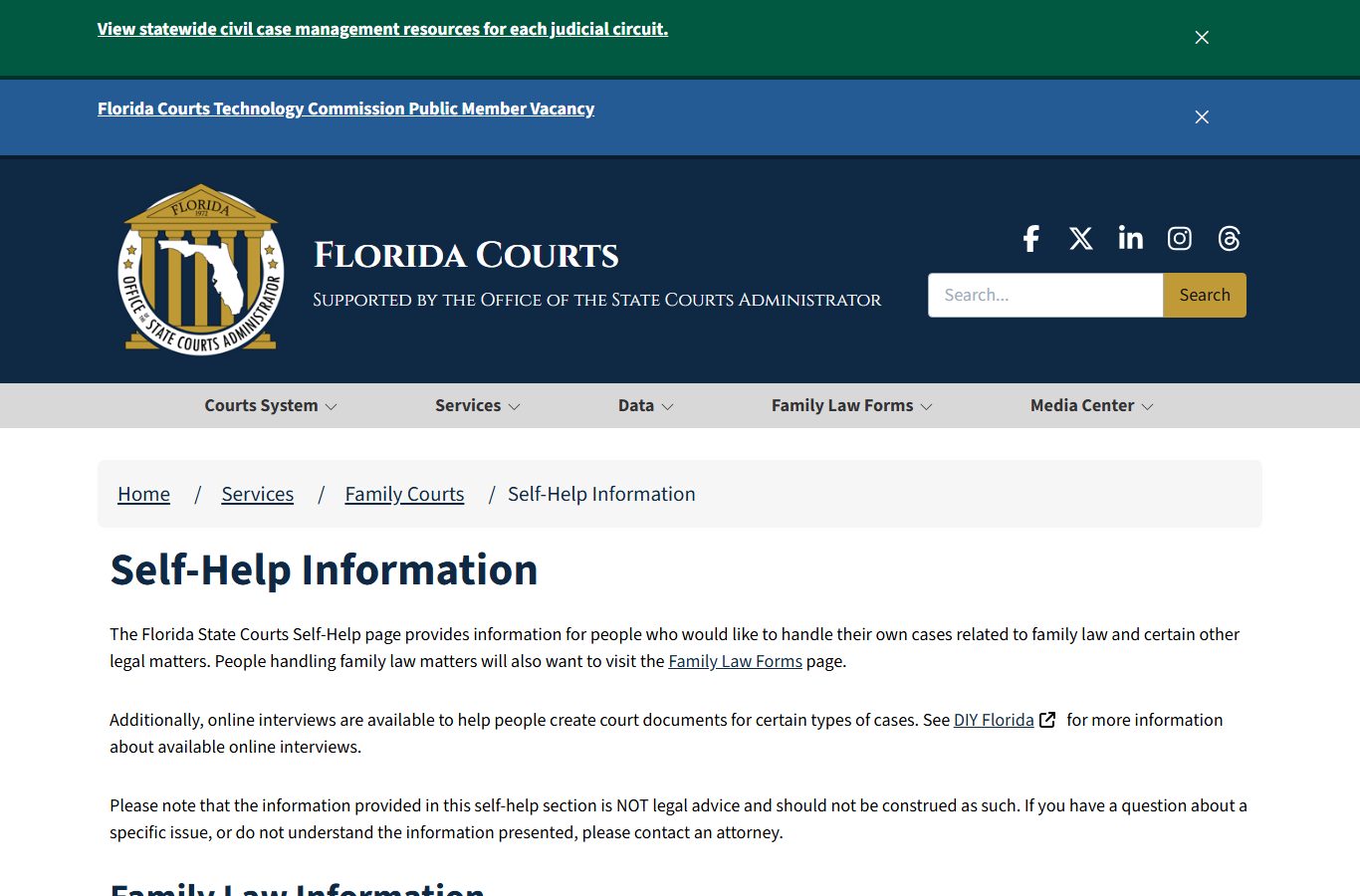
The Florida Courts self-help page provides approved family law forms, including forms for dissolution of marriage, paternity, child support, and name change, that St. Johns County residents can use without an attorney.
Getting Certified Copies of Marriage and Divorce Records
Certified copies of recorded marriage licenses come from the Clerk's Recording Division. You can request them in person at any Clerk location during business hours, by mail, or online through the Landmark system if the document is accessible there. The certified copy fee is $2 for the first certification, with additional certified copies at $3 each per the Clerk's FAQ. Plain copies are $1 per page.
Certified copies of final judgments of dissolution, name change orders, or other court documents from a family case are obtained through the Clerk's court records office or through E-Certify online. Court file copies cost $1 per page and court document certification costs $2. You will need the case number or the names of both parties and the approximate year of the final judgment. The Clerk's main phone number is (904) 819-3600, and criminal and family copy requests can be directed to the appropriate division. Call during business hours, Monday through Friday, 8:00 AM to 5:00 PM.